
Outdoor Kitchen Technology: What to Plan for in a Luxury Estate
An outdoor kitchen is no longer simply a grill placed near the patio.
In a well-designed luxury estate, it often functions as a complete extension of the home. It may support casual family meals, large gatherings, poolside entertaining, evening events, and year-round outdoor living.
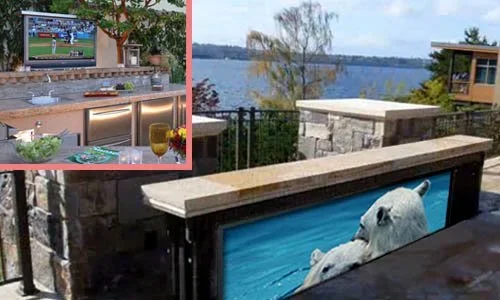
The most successful outdoor kitchens feel effortless to use. That experience depends on more than appliances and finishes. It requires careful coordination of power, connectivity, lighting, audio, climate, security, and control before construction and landscaping are complete.
Start With How the Space Will Be Used
Technology planning should begin with the intended experience.
Some outdoor kitchens are designed for small family dinners. Others support catered events, pool parties, or large groups moving between the house, terrace, pool, and lawn.
The right design depends on practical questions:
How often will the kitchen be used?
Will it support everyday meals, formal entertaining, or both?
How many guests should the space accommodate?
Will the area be used after dark?
Does the kitchen need to connect with a pool, pavilion, guest house, or dining terrace?
Will homeowners, staff, or outside caterers use the space?
Is the kitchen intended for seasonal or year-round use?
These decisions affect everything from Wi-Fi coverage and lighting to appliance power, audio zones, and control locations.
Reliable Wi-Fi and Network Coverage
Outdoor kitchens increasingly depend on a reliable network.
Connected appliances, music streaming, televisions, lighting control, security cameras, intercoms, and mobile devices may all rely on strong connectivity. A signal from inside the home is often not enough, particularly on larger properties or where stone, steel, concrete, glass, and landscaping interfere with coverage.
A properly planned outdoor network may include:
Exterior Wi-Fi Access Points
Outdoor-rated access points can provide more predictable coverage around the kitchen, dining area, pool, and nearby gathering spaces.
Hardwired Connections
Televisions, control equipment, networked appliances, and other fixed devices may perform more reliably with a hardwired connection.
Connectivity Between Structures
Pavilions, pool houses, guest houses, bars, and detached kitchens may require dedicated network pathways rather than relying on wireless coverage from the main residence.
The network should be planned around the entire outdoor experience, not treated as an extension of the nearest indoor router.
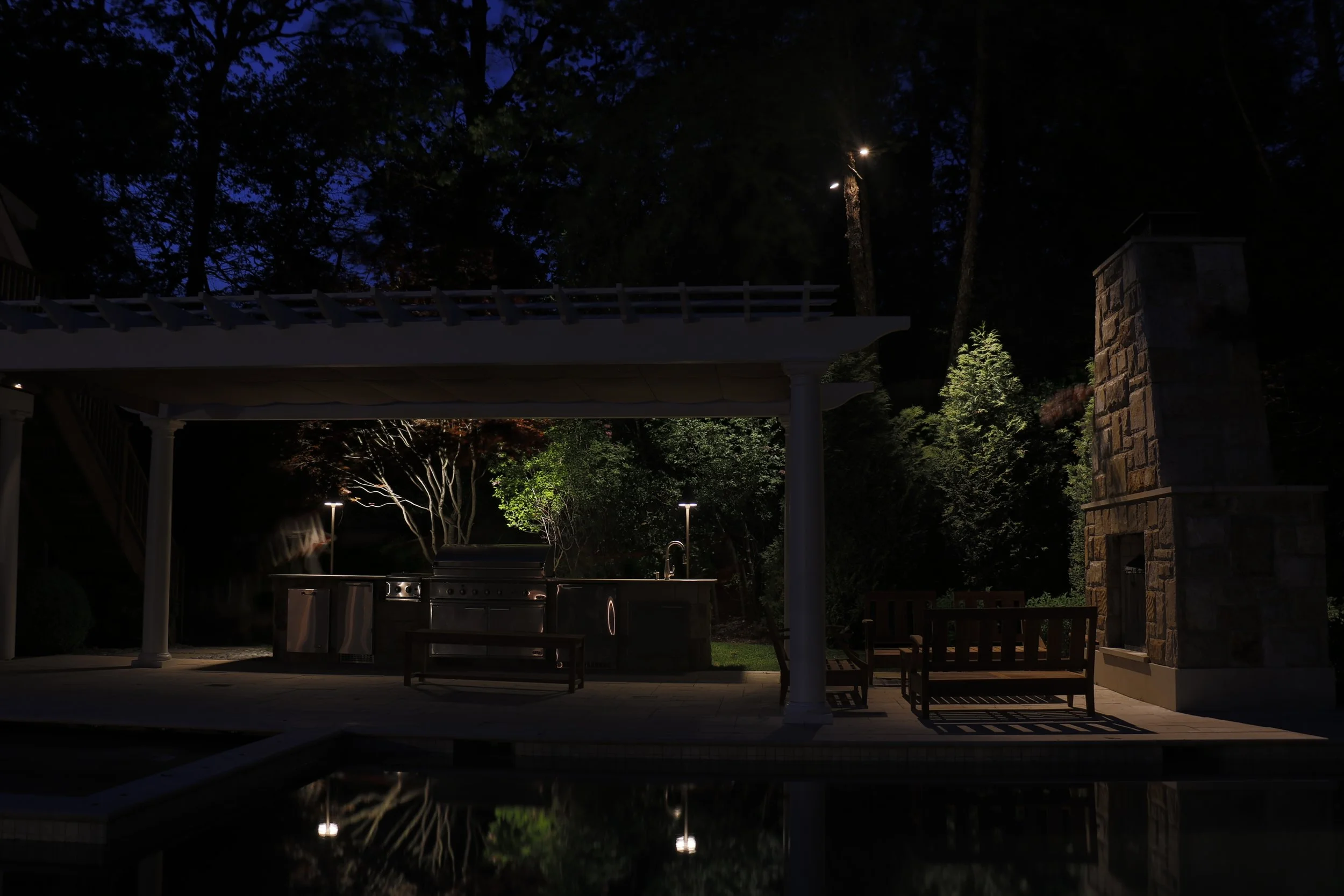
Without proper lighting, your outdoor kitchen doesn’t support you after the sun goes down.
Lighting for Cooking, Dining, and Entertaining
Outdoor kitchen lighting needs to support several different activities.
Task lighting should make food preparation and cooking comfortable. Dining areas benefit from softer, warmer illumination. Paths, steps, and level changes need enough light for safe movement. Architectural and landscape lighting can then connect the kitchen visually with the rest of the property.
A thoughtful lighting plan may include:
Task lighting over counters and grills
Lighting inside cabinets and storage areas
Pendant or decorative lighting over dining areas
Step and pathway lighting
Landscape lighting around surrounding plantings
Accent lighting for architectural features
Low-level lighting for late-evening use
The goal is balance. The kitchen should be functional without feeling overly bright or separate from the surrounding nightscape.
Lighting controls can also make the space easier to use. Rather than adjusting individual fixtures, homeowners can select a coordinated setting for cooking, dining, entertaining, or closing the property for the evening.
Outdoor Audio
Music often helps define the atmosphere of an outdoor kitchen.
Good outdoor audio should feel evenly distributed across the space rather than coming from one loud location. Multiple carefully positioned speakers can provide comfortable coverage at lower volume, making conversation easier and reducing sound spill into neighboring areas.
On larger estates, the outdoor kitchen may be one part of a broader audio plan that includes:
Pool and spa areas
Covered terraces
Gardens
Fire features
Sports courts
Guest houses
Lawns and entertaining spaces
Each area may need independent control so music can follow the activity without playing across the entire property.
Television and Entertainment
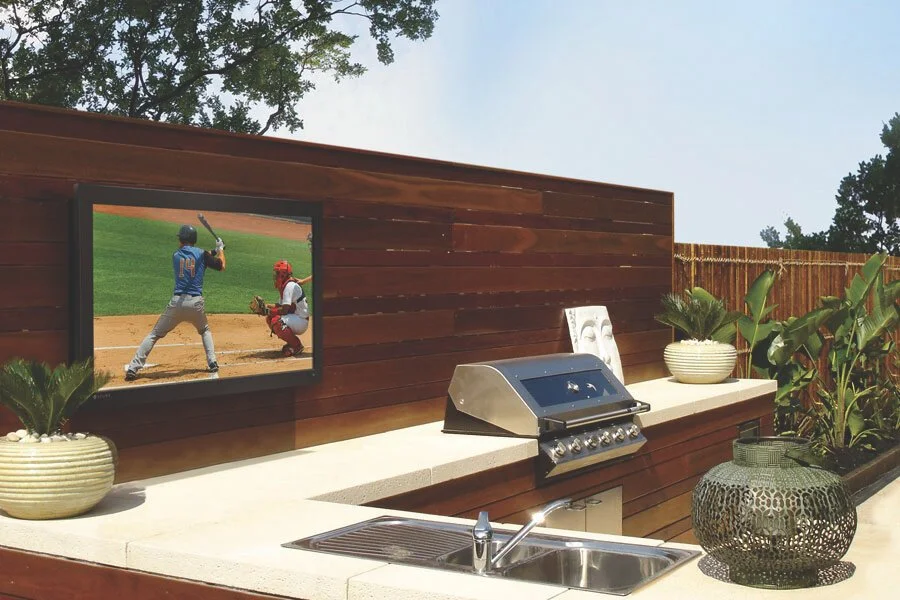
A television can make an outdoor kitchen more useful for sports, casual gatherings, and family events, but placement requires careful thought.
The screen should be protected from weather while remaining visible from the primary seating and cooking areas. Sunlight, glare, viewing height, heat, and cable routing all need to be considered before the structure is complete.
Outdoor televisions should also be supported by reliable power, network connectivity, and a practical source-control plan. Equipment should be located where it remains accessible for service without interrupting the design.
Not every outdoor kitchen needs a screen. In some settings, omitting it creates a calmer and more architectural environment. The choice should support how the estate is actually used.
Appliance and Utility Coordination
Outdoor kitchens may include grills, smokers, pizza ovens, refrigeration, ice makers, warming drawers, dishwashers, beverage centers, or specialty cooking equipment.
Each appliance has its own requirements for power, gas, ventilation, water, drainage, clearance, and service access. These needs should be coordinated with the architect, builder, kitchen designer, electrician, plumber, landscape team, and technology integrator.
Early coordination helps prevent common problems such as:
Insufficient electrical capacity
Inconvenient outlet locations
Limited ventilation
Equipment that cannot be serviced easily
Visible wiring or conduit
Conflicts between appliances, cabinetry, and controls
Network-dependent equipment without reliable coverage
Technology should be integrated into the design rather than added after the cabinetry and finishes have been selected.
Climate and Comfort
Luxury outdoor living often extends beyond the mildest months of the year.
Depending on the location and design, an outdoor kitchen may use overhead heaters, fans, motorized screens, insect-control systems, or automated shading to improve comfort.
These systems need coordinated power, control wiring, mounting locations, and structural support. They may also be grouped into simple operating modes so the space can be prepared without adjusting each system separately.
A single command might activate the kitchen lighting, turn on selected audio zones, lower screens, and prepare the climate systems for an evening gathering.
The technology should simplify the experience, not make the space feel complicated.
Security and Property Awareness
Outdoor kitchens often contain valuable appliances, televisions, furnishings, and equipment. They may also be located some distance from the main house.
Cameras can provide visibility around cooking areas, entries, gates, pool spaces, and nearby structures. Door or gate stations may help homeowners communicate with arriving guests or service providers. Water sensors can provide early notice of leaks near sinks, refrigeration, or plumbing connections.
Security planning should remain discreet. Cameras and other devices should be positioned carefully so they support property awareness without dominating the design.
Weather Protection and Equipment Durability
Outdoor technology must be selected and installed for real-world conditions.
Heat, moisture, salt air, wind, insects, freezing temperatures, and direct sunlight can affect performance. Even covered outdoor kitchens are not the same as indoor rooms.
Equipment enclosures, wiring methods, ventilation, drainage, and mounting locations should reflect the specific environment. Controls and devices should also remain accessible for maintenance and replacement.
A clean installation is important, but serviceability matters just as much. Equipment that cannot be reached easily may become expensive or disruptive to maintain later.
Simple, Coordinated Control
An outdoor kitchen may include lighting, music, televisions, shades, heaters, fans, and security. Without a clear control plan, the space can become harder to operate than it needs to be.
Controls should be placed where they make sense for everyday use. Homeowners may use a combination of weather-resistant keypads, handheld remotes, touchscreens, and mobile devices.
Frequently used settings can be grouped into simple scenes, such as:
Cooking
Brighter task lighting, comfortable background audio, and selected ventilation or climate systems.
Dinner
Softer lighting around the kitchen and dining table, with surrounding landscape lighting brought into balance.
Entertaining
Coordinated lighting, audio, television, and comfort settings across the primary gathering areas.
Closing
Entertainment systems turn off, lighting returns to a security setting, and selected doors or gates can be checked.
The best control experience is not the one with the most options. It is the one that makes the space predictable and easy to use.
How Outdoor Kitchens Fit Into a Luxury Estate
On a large property, the outdoor kitchen rarely operates as an isolated feature.
It may connect the main residence with the pool, guest house, pavilion, lawn, waterfront, or garden. Its technology should therefore be considered as part of the estate’s larger infrastructure.
This may involve:
Extending the property network across long distances
Coordinating audio across several outdoor zones
Connecting the kitchen with gates and entry systems
Providing communication with the main house
Integrating lighting with the broader landscape plan
Supporting staff, catering, and service access
Preparing pathways for future structures or amenities
A coordinated estate-wide approach creates a more consistent experience and makes the systems easier to manage and support.
Plan Before the Hardscape Is Complete
The best time to plan outdoor kitchen technology is before foundations, masonry, cabinetry, landscaping, and hardscaping are finished.
At that stage, the project team can still coordinate conduit, wiring, drainage, network routes, equipment locations, speaker placement, lighting, and future pathways.
Once stone, concrete, finished ceilings, and planted areas are in place, changes can become more disruptive. The work may still be possible, but the available routes and equipment locations are often more limited.
Early planning protects the design and gives each trade clearer direction.
A Better Outdoor Experience Begins Behind the Scenes
A successful outdoor kitchen should feel comfortable, intuitive, and connected to the rest of the property.
That experience depends on infrastructure that is rarely visible: reliable networking, coordinated power, thoughtful lighting, evenly distributed audio, practical control, and equipment that can be maintained over time.
HTE helps homeowners, architects, builders, and landscape teams plan these systems before construction limits the available options.
Planning an outdoor kitchen or larger estate renovation? Schedule a project review with HTE before the infrastructure and finishes are finalized.
Frequently Asked Questions About Outdoor Kitchen Technology
When should technology planning begin for an outdoor kitchen?
Technology planning should begin before electrical work, cabinetry, masonry, hardscaping, and landscaping are finalized. Early coordination makes it easier to plan clean pathways for power, wiring, Wi-Fi, lighting, audio, controls, and future additions before finished surfaces limit access.
Why does outdoor kitchen technology need to be planned early?
Outdoor kitchens often involve several trades working in the same area, including builders, electricians, landscape architects, masons, cabinet suppliers, AV teams, and lighting designers. Planning early helps prevent visible wiring, awkward equipment locations, weak connectivity, and costly changes after stone, cabinetry, concrete, or landscape work is complete.
What technology should be considered for an outdoor kitchen?
Common considerations include outdoor Wi-Fi, lighting control, outdoor audio, television, surveillance, motorized screens, heaters, fans, appliance connectivity, water-leak monitoring, and integrated controls. The right mix depends on how the space will be used: everyday cooking, casual dining, entertaining, poolside gatherings, sports viewing, or larger estate events.
Does an outdoor kitchen need dedicated Wi-Fi?
Many outdoor kitchens benefit from dedicated outdoor Wi-Fi coverage. Distance from the main house, masonry, exterior walls, glass, metal, and surrounding structures can weaken the indoor signal. Outdoor-rated access points can provide more reliable coverage for phones, tablets, streaming, control systems, cameras, and connected appliances.
Should an outdoor television use a wired network connection?
When construction allows, a hardwired network connection is often the better choice for an outdoor television. It can provide more predictable performance for streaming, updates, control, and service support while reducing dependence on wireless signal strength.
Does every outdoor kitchen need a television?
No. A television can be useful for sports, casual entertaining, and poolside gatherings, but it should support the intended experience. Some outdoor kitchens benefit from a screen, while others feel more refined, quiet, and architectural without one.
What should be considered when placing an outdoor television?
Important factors include sunlight, glare, viewing distance, weather exposure, heat, mounting height, power, network connectivity, structural support, and future service access. These details should be coordinated before surrounding cabinetry, stone, ceilings, pergolas, or finished surfaces are complete.
How should outdoor kitchen lighting be planned?
Outdoor kitchen lighting should support cooking, food preparation, dining, movement, safety, and atmosphere. A well-planned design may include task lighting, cabinet lighting, decorative fixtures, step lights, path lighting, grill lighting, and nearby landscape or architectural lighting.
Can outdoor kitchen lighting connect with the rest of the property?
Yes. Outdoor kitchen lighting can be coordinated with nearby terraces, pools, gardens, pathways, pavilions, guest houses, and architectural lighting. Preset scenes can make it easier to shift from cooking to dining, entertaining, evening cleanup, or closing the property for the night.
What is an outdoor kitchen scene?
A scene is a preset group of settings designed around a specific activity. For example, a cooking scene might brighten task lighting and turn on background music, while a dinner scene could soften the lighting, adjust nearby landscape areas, and lower the audio volume.
How are outdoor kitchen systems controlled?
Controls may include weather-resistant keypads, handheld remotes, touchscreens, mobile apps, or voice control where appropriate. The best design usually combines fixed controls in convenient locations with mobile access for flexibility.
Can heaters, fans, lighting, audio, and screens be controlled together?
Yes. Compatible systems can often be included in a coordinated control plan. Frequently used settings may combine lighting, screens, heaters, fans, audio, and entertainment into simple one-touch scenes.
What should be considered when planning outdoor audio?
Speaker placement should provide even coverage without forcing one area to be too loud. The outdoor kitchen may also need to operate as its own audio zone, separate from the pool, lawn, garden, pavilion, or other entertainment areas.
Can outdoor speakers disturb neighboring properties?
Yes, if they are poorly placed or played too loudly. A better approach is usually to use multiple carefully positioned speakers at lower volumes. This creates more even coverage for guests while helping keep sound more contained within the intended area.
Should security cameras cover an outdoor kitchen?
Security cameras may be appropriate when the kitchen includes valuable appliances, televisions, furnishings, audio equipment, or stored accessories. Cameras can also help monitor nearby doors, gates, pool areas, and service paths. Placement should be discreet and respectful of outdoor gathering spaces.
Are water sensors useful in an outdoor kitchen?
Yes. Water sensors can provide early notice of leaks near sinks, ice makers, refrigerators, dishwashers, and plumbing connections. They are especially useful in seasonal kitchens, detached structures, or areas located away from the main residence.
Can standard indoor technology be used outside?
Not usually. Outdoor equipment must be selected for the conditions it will face, including moisture, heat, direct sun, wind, freezing temperatures, salt air, insects, and seasonal use. Even covered outdoor kitchens require careful equipment selection and placement.
How should outdoor equipment be protected?
Outdoor equipment may require weather-rated devices, proper enclosures, ventilation, drainage, protected wiring methods, and thoughtfully chosen mounting locations. Equipment should be protected from the elements while remaining accessible for service and maintenance.
Should detached outdoor kitchens have their own technology equipment?
It depends on the distance from the main residence, the available infrastructure, and the systems being supported. Some detached outdoor kitchens, pavilions, pool houses, and cabanas may need dedicated network equipment, local controls, electrical coordination, or structured connections back to the estate’s main system.
How does an outdoor kitchen connect with the rest of a luxury estate?
An outdoor kitchen may share networking, lighting, audio, video, surveillance, access control, and automation with the main house, pool, guest house, pavilion, gates, gardens, and service areas. Planning these areas together creates a more consistent experience across the property.
How can an outdoor kitchen be prepared for future technology?
Conduit, spare wiring, accessible equipment locations, and additional network pathways can preserve flexibility. These details are especially valuable in areas that will be difficult to reach after masonry, concrete, cabinetry, decking, or landscaping is finished.
What information is helpful for an outdoor kitchen technology review?
Helpful materials include architectural plans, kitchen elevations, appliance schedules, electrical plans, lighting plans, landscape drawings, hardscape plans, furniture layouts, and information about nearby pools, pavilions, guest houses, gates, or entertainment areas.
What does HTE review during outdoor kitchen planning?
HTE reviews network coverage, lighting and control requirements, audio and entertainment goals, equipment locations, surveillance needs, property-wide integration, service access, and future expansion pathways. Recommendations are coordinated with the homeowner and project team before construction limits the available options.
Why work with HTE during outdoor kitchen planning?
HTE helps coordinate the technology behind the outdoor experience so it supports the design rather than competing with it. By planning early, the outdoor kitchen can be more reliable, more discreet, easier to use, and better connected to the rest of the property.