
Motorized Drapery as an Architectural Detail in Your Home
Lutron Palladiom Drapery: When Motorized Drapery Becomes an Architectural Detail
Motorized drapery should not force a choice between convenience and a room that feels carefully composed. The right system can protect privacy, manage daylight, and support daily routines while still respecting the fabric, hardware, millwork, and architecture around it.
Lutron’s Palladiom Drapery takes a distinct approach. Rather than hiding the track in a ceiling pocket or behind millwork, it gives the hardware an intentional role in the room. For homeowners, architects, and interior designers, that creates another way to combine custom fabric, refined metalwork, and quiet control without turning the technology into the focal point.
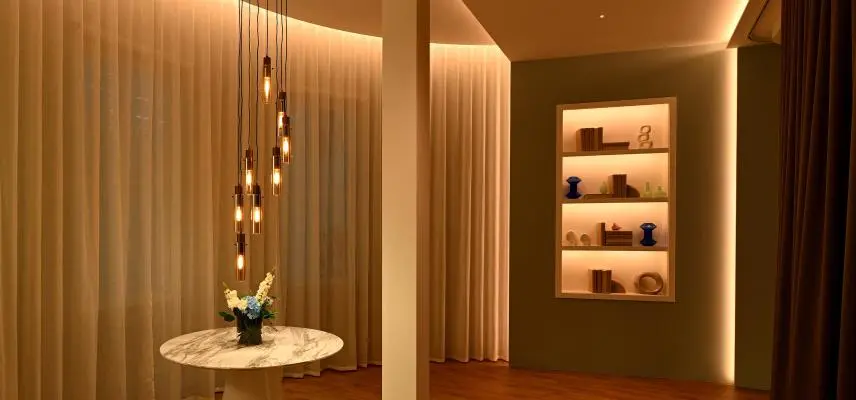
An Exposed Drapery Track Designed to Be Seen
Concealed drapery tracks remain an excellent choice for many homes. They can disappear into ceiling pockets, recessed channels, and custom millwork when that is the desired effect. But concealed installation needs early planning, adequate depth, and coordination across several trades.
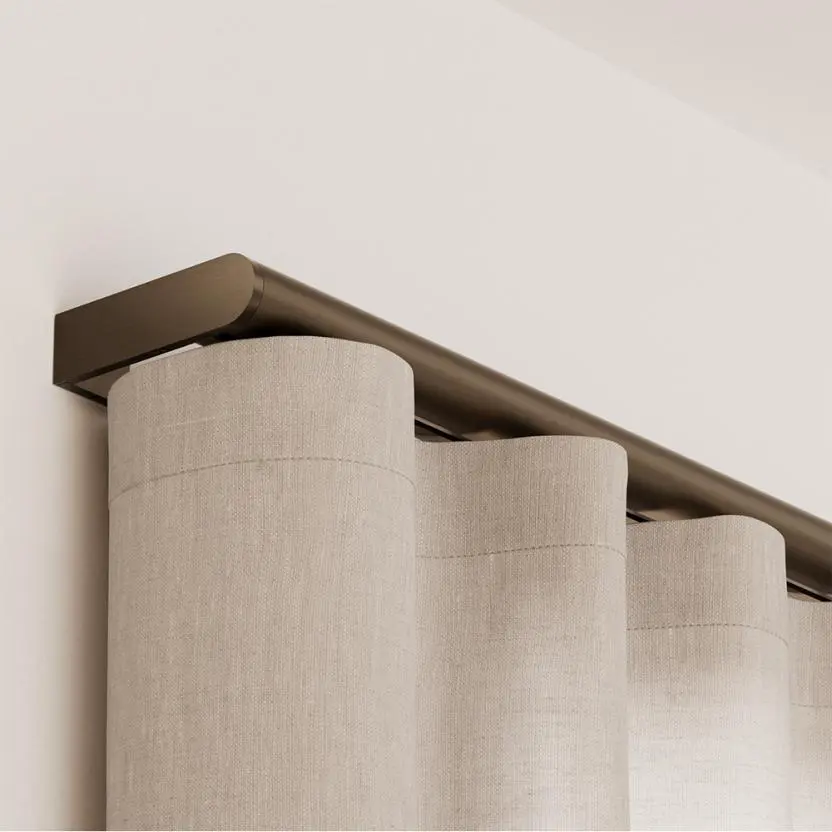
Palladiom Drapery offers a different design language. Its wall-mounted, exposed track is intended to sit in a clear relationship to the wall, with the drive, carriers, and reinforcement contained within the track’s slender profile. The result is hardware that reads as a deliberate architectural detail rather than an exposed mechanical component.
That makes it particularly useful where a pocket is unavailable, where an existing home is being thoughtfully updated, or where the drapery hardware should complement the room’s metal finishes and furnishings. Lutron offers the system in five hand-finished aluminum finishes, with multiple end treatments and draw configurations to suit the application.
More Freedom for the Interior Design Team
Palladiom Drapery is compatible with nearly any custom-fabricated drapery material. That gives the interior designer and workroom room to prioritize the fabric itself: its weight, texture, color, fullness, pleat style, and relationship to the rest of the room.
That flexibility matters because motorization should support the design decision, not narrow it. A tailored linen ripple fold, a more formal pinch pleat, or a substantial room-darkening drapery can each call for different planning, but the visual direction should begin with the room.
For a broader look at fabric, privacy, glare control, and power choices, see our guide to choosing motorized window treatments for your home.
Planning for Larger Openings and Heavier Fabric
Palladiom Drapery is designed for more than decorative panels. Lutron specifies straight tracks up to 12 feet without a splice and up to 30 feet with splicing, subject to the final configuration and fabric load. Available arrangements include left draw, right draw, center draw, and tandem configurations.
A tandem configuration uses two tracks and dedicated drives so longer center-draw openings or heavier drapery can move together in a coordinated way. That can be especially relevant in large living rooms, primary suites, great rooms, and spaces with expansive glass.
Before the track is ordered, the project team should resolve:
- Fabric weight, fullness, and pleat style
- Track length, draw direction, and end treatment
- Structural blocking and appropriate mounting conditions
- Low-voltage power and communication requirements
- Clearances for trim, window hardware, millwork, and furniture
These are not last-minute installation details. They shape how the drapery hangs, moves, and belongs to the room. This is why planning wiring for motorized shades before construction closes preserves more options and avoids a retrofit appearance later.
Quiet Control That Belongs to the Home
The value of motorized drapery is not simply that fabric moves when someone presses a button. It is that daylight, privacy, and room atmosphere can become part of the home’s natural rhythm.
Palladiom Drapery can operate with standalone wired or wireless controls, or integrate with Lutron HomeWorks QSX, RadioRA 3, RA2 Select, and Caséta systems when the project calls for broader coordination. In a well-planned home, the experience can remain simple:
- A morning scene opens drapery and brings the room to a comfortable light level.
- An evening scene closes drapery, adjusts the lights, and prepares the room for dinner or relaxation.
- A media scene reduces exterior light without requiring a series of separate adjustments.
- An away setting places window treatments in a predetermined position.
The homeowner sees a calm, familiar response. Behind it is a coordinated relationship between drapery, lighting, controls, power, and the architecture. Our lighting control approach is built around that same principle: everyday control should be intuitive, visible when needed, and quiet when it is not.
When Palladiom Drapery Makes Sense
Palladiom may be a strong fit when the exposed track should feel intentional, the project calls for broad custom-fabric freedom, or a recessed pocket is unavailable or inconsistent with the design. It is also worth considering for substantial openings where the scale of the architecture calls for equally substantial drapery.
The right specification always depends on the opening, wall construction, available power, fabric, and desired control experience. A new home, renovation, or carefully planned retrofit can all be appropriate settings. The key is selecting the system early enough that the architecture and technology can support one another.
The Whole Window Treatment Needs to Be Planned Together
Successful motorized drapery is not created by selecting a track alone. Fabric weight affects motor selection. Pleat style changes the way panels hang and stack. Wall construction determines how brackets are supported. Power and communication requirements affect the electrical plan. Adjacent molding, furniture, hardware, and millwork all influence the final track location.
At Home Technology Experts, we work alongside homeowners, architects, interior designers, builders, electricians, and drapery professionals to resolve those details before installation. We can also connect the finished window treatments to a broader whole-home control plan when that serves the way the household lives.
For projects deciding between power approaches, our comparison of wired and battery-powered motorized shades explains the practical tradeoffs. For projects where lighting and shades need to respond together, explore lighting control options for luxury homes.
Frequently Asked Questions About Palladiom Drapery
Can Palladiom Drapery be used without a whole-home automation system?
Yes. It can operate with standalone wired or wireless controls. Whole-home integration is an option when the project would benefit from coordinated lighting, shades, and routines.
Does Palladiom Drapery need to be planned before construction?
Early planning is ideal, especially when power, blocking, millwork, or coordinated lighting scenes are involved. A retrofit may still be possible, but the existing wall construction and access need to be evaluated first.
Can Palladiom Drapery use custom fabric?
Yes. The system is compatible with nearly any custom-fabricated drapery material. Fabric weight, construction, fullness, and pleat style should be reviewed before the drive and track configuration are finalized.
Is an exposed drapery track right for every room?
No. Some interiors call for a concealed pocket or fascia. Palladiom is most compelling where visible hardware will contribute positively to the room’s composition or where a pocket is not practical.
A More Considered Approach to Motorized Drapery
Palladiom Drapery reflects a useful shift in residential technology. Functional equipment does not need to look separate from the interior architecture. With the right planning, it can become part of the room’s composition while remaining quiet, dependable, and easy to use.
That is where home technology works best: not as an afterthought added to the finished design, but as a coordinated part of it from the beginning.
Related reading: Choosing Motorized Window Treatments for Your Home, Why Wiring Matters for Motorized Shades, and Intelligent Lighting Control by Lutron.