
Ceiling Speakers for Home Audio: What to Plan Before Installation
Ceiling Speakers for Home Audio
Great audio should feel natural in a home. It should be there when you want it and fade into the background when you do not.
Ceiling speakers are one of the most effective ways to create that experience. They can provide music throughout a home without adding visible speakers to countertops, walls, bookshelves, or furniture. They also work particularly well in homes where architecture and interior design need to remain visually quiet.
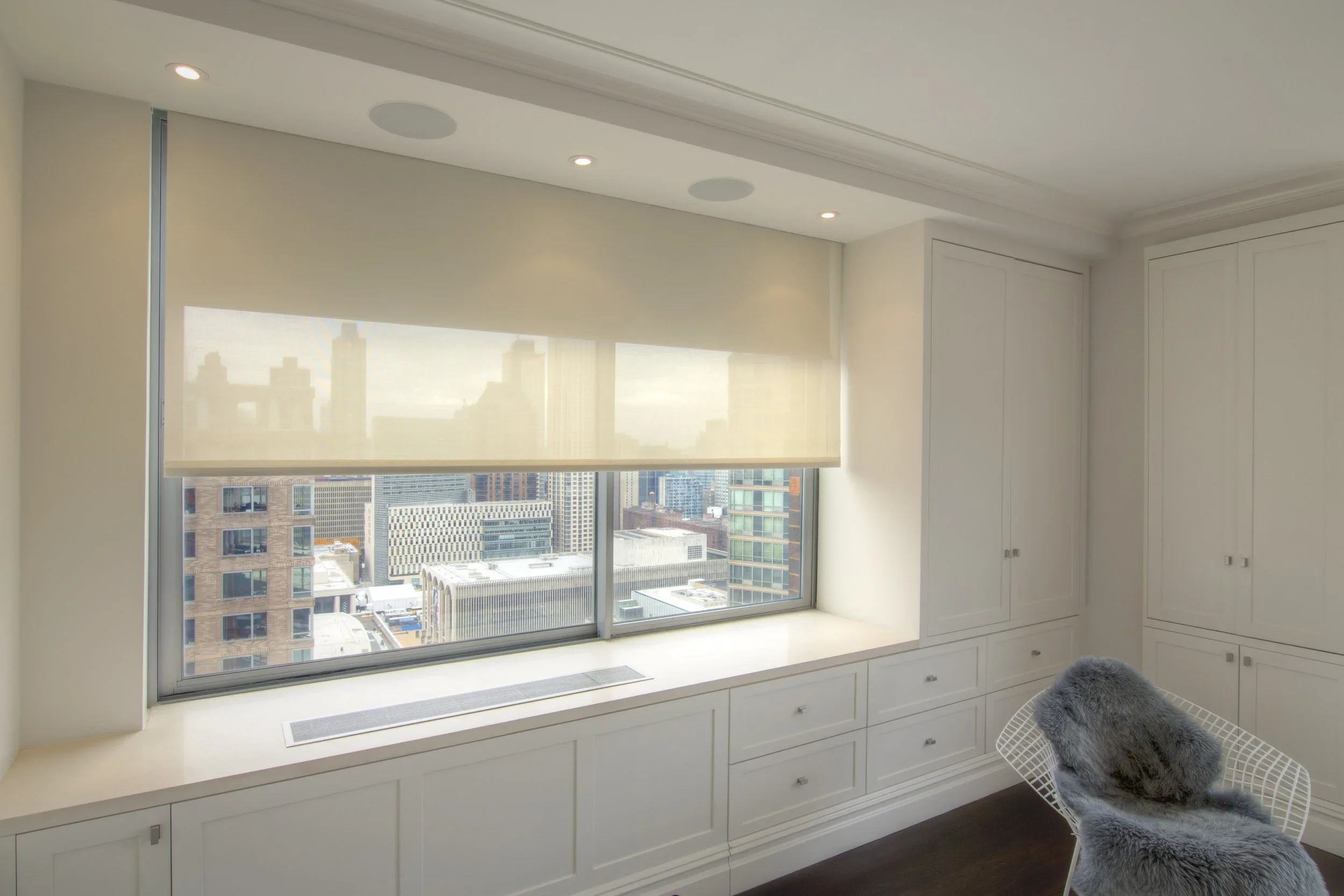
In-ceiling speakers and motorized shades
But not all ceiling speakers are the same.
Today, homeowners can choose from traditional architectural speakers, small-aperture speakers, invisible speakers, high-performance in-ceiling models, directional speakers, weather-resistant options, and even different grille shapes and finishes. The right choice depends on the room, the desired sound quality, the architecture, and how visible—or invisible—the technology should be.
More importantly, the result usually depends as much on planning, placement, construction, amplification, and calibration as it does on the speaker itself.
When those decisions are made early, ceiling speakers can deliver balanced, enjoyable sound while remaining almost unnoticed within the finished home.
What Are In-Ceiling Speakers?
In-ceiling speakers are architectural loudspeakers installed within the ceiling rather than placed visibly in the room.
Most consist of a speaker enclosure or driver assembly recessed above the finished ceiling and a grille that sits nearly flush with the surface. Depending on the product, the grille may be round, square, very small, custom finished, or completely concealed beneath the final ceiling material.
They are commonly used for:
Whole-home and distributed audio
Kitchens and great rooms
Bedrooms and home offices
Bathrooms and dressing rooms
Covered outdoor areas
Surround-sound channels
Dolby Atmos and other immersive-audio height channels
The important distinction is that an “in-ceiling speaker” describes where the speaker is installed—not its performance level.
A basic architectural speaker and a high-performance architectural speaker may look nearly identical after installation while performing very differently.
Standard Architectural Ceiling Speakers
Traditional architectural ceiling speakers remain one of the most practical choices for whole-home audio.
These typically use a round or square paintable grille approximately six to ten inches in diameter, depending on the speaker.
They work particularly well for rooms where the goal is good, consistent music coverage rather than creating a dedicated critical listening environment.
A properly designed system might use them throughout kitchens, bedrooms, hallways, offices, bathrooms, and general living spaces.
The advantage is a strong balance between:
Sound quality
Cost
Installation flexibility
Reliability
Serviceability
Visual discretion
For many homes, a well-designed architectural speaker system is all that is necessary.
Small-Aperture Speakers: When the Ceiling Design Matters
One of the most interesting developments in architectural audio is the small-aperture speaker.
Instead of exposing a traditional six- or eight-inch grille, these systems use a much smaller visible opening—sometimes only a few inches across—while the larger acoustic components remain concealed above the ceiling.
The result can be especially attractive in highly designed homes.
Small-aperture speakers can coordinate beautifully with:
Minimalist ceiling designs
Linear lighting
High-end millwork
Contemporary architecture
Carefully organized reflected ceiling plans
Rather than having several large speaker grilles competing visually with lighting and HVAC, the speaker openings can become another small, intentional element within the ceiling.
There is usually more engineering happening above the ceiling than the finished room suggests. Some small-aperture systems use remote woofers, specialized enclosures, or other acoustic techniques to produce full-range sound from a very discreet opening.
They are a good example of an important principle in residential technology:
The less technology you want to see, the more carefully it usually needs to be planned.
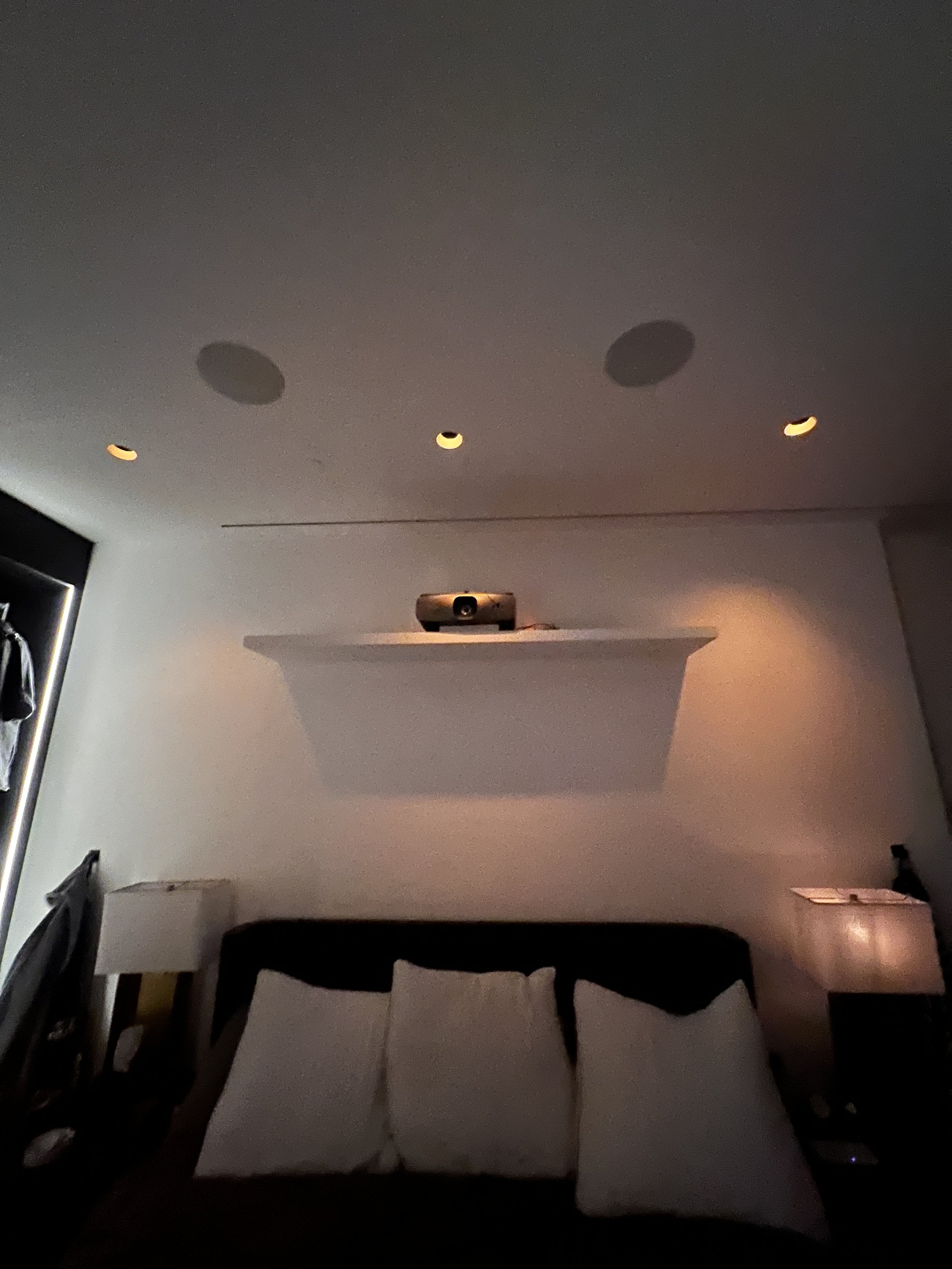
Invisible Speakers: When You Do Not Want to See a Speaker at All
For certain interiors, even a small grille is one visual element too many.
That is where invisible speakers can become an option.
Invisible architectural speakers are installed into the wall or ceiling and finished over using an approved plaster, skim-coat, wallpaper, or similar finish system. Once completed properly, there may be no visible grille at all.
The speaker effectively becomes part of the architectural surface.
Invisible speakers can be particularly useful in:
Formal living rooms
Minimalist interiors
High-end kitchens
Primary bedrooms
Galleries
Historic interiors
Rooms with specialty plaster
Spaces where ceiling symmetry is extremely important
They require more coordination than conventional ceiling speakers.
The speaker model, finish thickness, mounting method, installation depth, surrounding construction, and finishing technique all affect the result. The technology integrator and finishing contractor need to understand the requirements before installation begins.
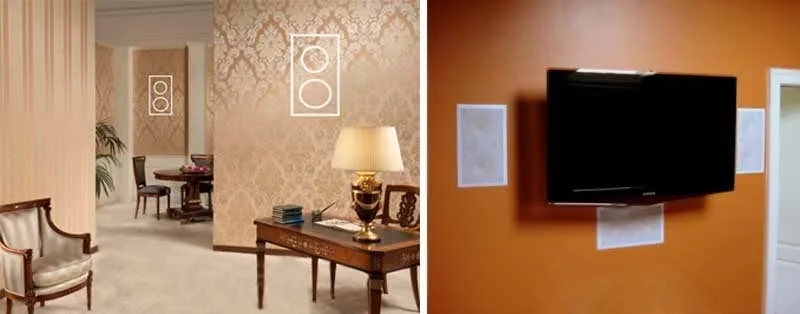
Invisible Speakers
Invisible speakers can produce excellent results, but they should be selected because they solve a specific architectural problem—not simply because “invisible” sounds better.
In some rooms, a conventional or small-aperture architectural speaker may provide more performance for the investment while still remaining extremely discreet.
Round vs. Square Speaker Grilles
This sounds like a small decision until someone begins laying out the ceiling.
Traditional ceiling speakers are often available with either round or square grilles.
Acoustically, grille shape is generally less important than the underlying speaker design. Visually, however, it can make a significant difference.
Round speakers often coordinate naturally with:
Round recessed lighting
Sprinkler heads
Other circular ceiling elements
Square grilles may make more sense when the architecture uses:
Square downlights
Linear geometry
Coffered ceilings
Rectilinear millwork
Contemporary detailing
Neither is inherently better.
The goal should be to make the speaker layout feel intentional within the entire reflected ceiling plan rather than designing the lighting, HVAC, sprinklers, shades, and speakers independently.
Sometimes the best speaker location acoustically needs to move slightly so the overall ceiling composition remains clean. Good design involves balancing both priorities.
High-Performance Architectural Speakers
A clean ceiling does not mean accepting background-level performance.
There is an entire category of high-performance architectural speakers designed for homeowners who want significantly better sound without placing conventional freestanding loudspeakers in the room.
These products may use:
Higher-quality drivers
Larger woofers
Angled or aimable drivers
More sophisticated crossovers
Engineered backboxes
Higher power handling
Greater dynamic range
Better bass extension
Improved dispersion control
They can be particularly valuable in large great rooms, primary living spaces, media rooms, entertaining areas, and other rooms where music is an important part of the experience.
This is also why judging an architectural speaker based only on grille size or appearance can be misleading.
Two speakers may look nearly identical once installed but have completely different capabilities above the ceiling.
Contractor-Grade vs. Performance Architectural Speakers
There is also a meaningful difference between an architectural speaker selected primarily to meet a construction budget and one selected around a specific performance goal.
Basic contractor-grade speakers may be perfectly appropriate for secondary rooms where music is primarily background listening.
That does not necessarily make them the right choice for every room.
A better approach is often to create performance tiers within the home.
For example:
Secondary bedrooms and hallways may use a straightforward architectural speaker.
Kitchens and main living spaces may receive a higher-performance model.
Large entertaining spaces may use premium architectural speakers with dedicated subwoofers.
Formal areas may use small-aperture or invisible speakers for aesthetic reasons.
A dedicated theater may use an entirely different loudspeaker strategy.
The entire house does not necessarily need the same speaker.
It needs the right speaker for each space.
Directional and Angled Ceiling Speakers
A conventional ceiling speaker generally disperses sound downward and outward.
But sometimes the speaker location and listening position do not align.
An angled or directional ceiling speaker can aim more acoustic energy toward the listening area rather than directly at the floor below it.
These can be especially useful around:
Televisions
Seating areas
Large rooms
Vaulted ceilings
Rooms where architectural conditions restrict speaker placement
Some architectural speakers also include pivoting or adjustable tweeters that allow finer tuning after installation.
The more directional a system becomes, however, the more important the layout becomes.
These products should be selected around an actual listening position rather than simply placed wherever there happens to be open ceiling space.
What Is a Speaker Backbox, and Do You Need One?
One of the least visible parts of an architectural audio system can also be one of the most important.
A speaker backbox is an enclosure installed behind the speaker within the ceiling or wall cavity.
Depending on the speaker and installation, a backbox can help:
Create a more predictable acoustic environment
Improve bass consistency
Control how the speaker interacts with the ceiling cavity
Reduce sound traveling into adjacent rooms
Reduce interaction between the speaker and insulation or construction materials
Protect the speaker
Improve repeatability between rooms
Some high-performance speakers are engineered around a specific manufacturer-designed backbox and should not be installed without it.
Other speakers are designed to operate in an open ceiling cavity.
This is why the question should not simply be, “Do ceiling speakers need backboxes?”
The better question is:
How was this particular speaker engineered to be installed?
That answer should guide the construction.
Speaker Backboxes and Sound Transfer Between Rooms
Backboxes are also worth considering when rooms are located above or beside one another.
A ceiling cavity can allow sound to travel farther through a home than homeowners expect.
This can become noticeable when, for example, music is playing in a kitchen directly beneath a bedroom.
A properly selected enclosure, along with thoughtful construction and acoustic treatment, can help reduce unwanted sound transfer.
It will not make every room acoustically isolated, but it can be an important part of the overall strategy.
This is particularly worth discussing early in homes with:
Bedrooms above entertaining spaces
Nurseries
Home offices
Guest suites
Multi-generational living arrangements
The Ceiling Itself Affects the Speaker
Architectural speakers do not operate independently of the surface around them.
Different ceiling conditions can affect installation and performance.
These may include:
Standard drywall
Double-layer drywall
Wood ceilings
Specialty plaster
Venetian plaster
Acoustic ceilings
Coffered ceilings
Beams
Fabric treatments
Millwork
Concrete construction
A speaker designed for conventional drywall may require a completely different detail when installed within a wood or plaster ceiling.
This is another reason speaker selection should happen while the architectural details are still being developed.
Waiting until the ceiling is finished can dramatically reduce the available options.
Good Sound Starts With the Layout
Ceiling speakers are frequently used for distributed audio, where the goal is smooth, even coverage throughout a room.
When they are planned properly, they reduce obvious hotspots and dead zones so the listening experience remains more consistent as people move through the space.
Consider an open-plan kitchen and living area.
A speaker plan based only on square footage might technically provide enough speakers, yet still perform poorly if most of the sound ends up above the kitchen island while the main seating area receives very little coverage.
Good speaker placement considers:
Ceiling height
Room dimensions
Furniture layout
Primary listening positions
Kitchen islands
Cabinetry
Openings into adjacent spaces
Ceiling geometry
Speaker dispersion
Listening volume
Room acoustics
Lighting locations
HVAC diffusers and returns
Sprinkler heads
Structural framing
Decorative ceiling elements
The question is not simply, “How many speakers fit in this room?”
It is:
Where do the speakers need to be so the room sounds natural and the ceiling still looks intentional?
More Speakers Are Not Always Better
One common misconception is that adding more ceiling speakers automatically improves the system.
It does not.
Too many speakers can create unnecessary cost, visual clutter, excessive volume, complicated amplification requirements, or an unnatural listening experience.
Too few can create the opposite problem: uneven coverage that forces one area of the room to become excessively loud before another area reaches a comfortable listening level.
The objective is appropriate coverage, not maximum speaker count.
Speaker dispersion, ceiling height, room geometry, listening level, and intended use should determine quantity and spacing.
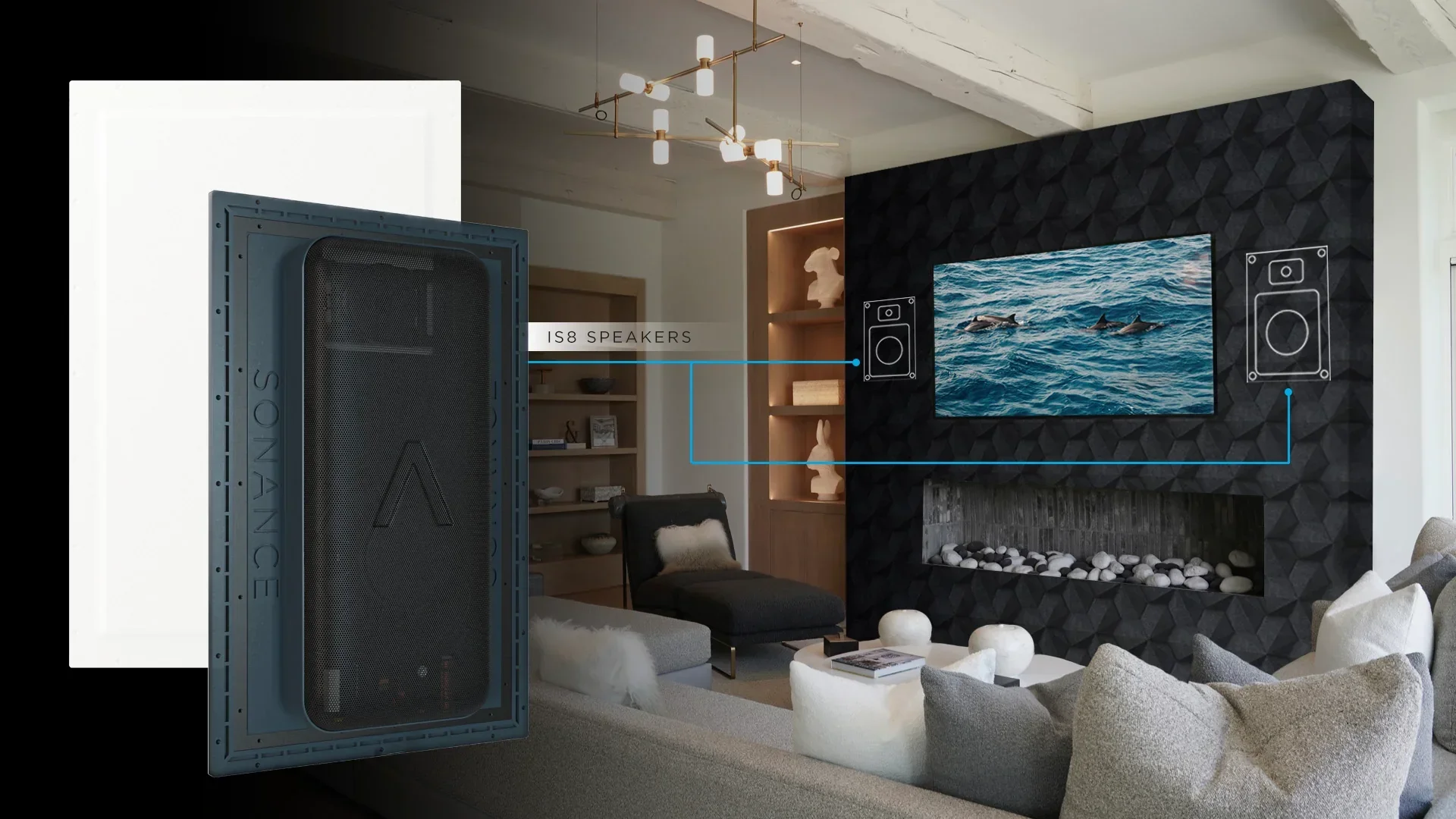
FAQs
Are ceiling speakers good for whole-home audio?
Yes. Ceiling speakers can be a strong foundation for whole-home audio because they provide clean room-by-room coverage without adding visible equipment to the space. The key is proper planning. Speaker placement should reflect the room size, ceiling height, furniture layout, and how each area is actually used.
Where should ceiling speakers be placed?
Ceiling speaker placement depends on the room. A good layout considers listening areas, ceiling height, lighting, HVAC, beams, millwork, and furniture placement. The goal is even sound coverage without awkward speaker locations or visual clutter on the ceiling. Another viable option is architectural speakers.
Can ceiling speakers be used in a media room?
Yes, but they should be part of a larger audio design. In media rooms, ceiling speakers are often used for surround or height effects. For dedicated theaters or high-performance listening spaces, speaker placement, acoustics, and calibration should be planned more specifically.
When should ceiling speakers be planned?
Ceiling speakers should be planned as early as possible in a new build or renovation. Once ceilings are closed and lighting, HVAC, and finish details are finalized, the best speaker locations may be limited. Early coordination usually leads to cleaner installation and better performance.
Can ceiling speakers be installed in bathrooms or outdoor areas?
Yes, in many cases, but the right products and conditions matter. Bathrooms, covered patios, and other moisture-prone areas may require speakers designed for those environments. Placement should also account for humidity, exposure, ceiling materials, and long-term serviceability.
Do ceiling speakers need to be connected to a control system?
Not always, but integration can make the system easier to use. When ceiling speakers are connected to a broader home control system, homeowners can manage music, volume, and room selection from a familiar interface instead of juggling separate apps or controls.