Will AI Replace Home Automation Systems?
Will Artificial Intelligence Replace Home Automation Systems?
By HTE’s Rhys Wescott
Artificial intelligence is already changing how people interact with technology, and the smart home is an obvious place for that change to accelerate.
The short-term answer is fairly straightforward: AI is not about to replace home automation systems. It is beginning to change how we communicate with them, how they are programmed, and how much they can learn about the people using them.
Over a longer horizon, however, the answer becomes more interesting.
If AI becomes capable of understanding a home, learning its occupants’ preferences, making decisions, and eventually interacting physically with the environment, the distinction between “AI” and “home automation” could become much less clear.
The progression may look something like this:
AI as an interface. AI as a programming assistant. AI as an increasingly autonomous agent.
We are already entering the first two stages.
Where AI in the Smart Home Is Today
One of AI’s most obvious advantages is language.
Traditional home automation is exceptionally good at executing defined commands. Press a button and a lighting scene activates. Select a room and music begins playing there. Trigger an Away scene and a predetermined list of actions occurs.
AI makes the front end of that experience more conversational.
Josh.ai is one of the clearest examples in the custom residential market today. Its current platform combines touch, text, voice, contextual awareness, and AI with control of compatible home technologies. Josh.ai also allows users to create scenes through natural-language instructions rather than building every action through a conventional programming interface.
That is meaningful progress.
It also demonstrates one of AI’s current limitations.
Imagine telling the house:
“I want to watch Slow Horses on Apple TV+.”
A system may understand exactly what you mean. It can turn on the television, select the appropriate source, launch Apple TV+, lower the shades, and adjust the lights.
Then the service asks which user profile is watching.
If the integration does not expose a way for the control system to select that profile, the AI cannot complete the request. Someone still has to pick up a remote.
The problem is not that the AI failed to understand “Slow Horses.” The limitation is further downstream: AI can only act through the controls and software interfaces available to it.
That distinction matters.
A very intelligent AI sitting on top of a poorly integrated device is still limited by what that device allows it to do.
Conversation May Replace Menus Before AI Replaces Automation
The more immediate change may have less to do with the house making decisions for us and more to do with how we configure it.
Today, a homeowner who wants to change a professionally programmed system may need an integrator for surprisingly simple requests:
“Make the kitchen lights 20% brighter in the Entertain scene.”
“Rename Pool Patio to West Terrace.”
“Have the shades close a little later.”
Those requests are simple in plain English. Making them happen in the back end of a Control4, Savant, lighting, shading, or other control environment can require specialized knowledge.
AI creates the possibility of sitting between those two worlds.
Instead of learning the programming software, the homeowner could describe the desired change conversationally. AI could translate that request into the appropriate system configuration, explain what it intends to change, and allow the homeowner to approve it.
That does not eliminate professional design and engineering. Someone still has to determine how systems communicate, what equipment is appropriate, how networks are designed, where devices are located, what happens during failures, and how the entire property functions as a system.
But it could reduce the amount of professional programming required for routine adjustments after the system is installed.
That would be a meaningful improvement in the ownership experience.
AI Could Also Explain the Home
The same idea applies to troubleshooting.
Today, “Why isn’t the patio music working?” can lead to a service call.
A future AI layer could potentially inspect what the system already knows:
The amplifier is online. The streamer is responding. The correct source is selected. The patio zone is active—but the amplifier has entered protection mode.
Instead of presenting a device fault or error code, it could simply explain the problem in understandable language and recommend the next step.
That progression is likely to happen incrementally:
Natural-language control → natural-language programming → better diagnostics → learned patterns and suggestions → increasingly proactive automation.
The first steps are already visible. The later ones require much more trust.

Will AI replace home automation systems?
The More Interesting Step: A Home That Learns Context
Most automation today depends on rules that someone intentionally creates.
If this happens, do that.
At this time, activate this scene.
When this button is pressed, set these lights to these levels.
AI potentially makes the relationship more fluid because it can recognize context rather than requiring a separate preset for every situation.
Imagine telling the house:
“Jess is coming over for dinner.”
If Jess has been over enough times, the home might know that those evenings tend to follow a pattern. Perhaps a particular artist usually plays. The kitchen and terrace are used more than the living room. The dining lights are normally set lower. The shades tend to stay open until later.
Instead of requiring someone to create and maintain a dedicated “Dinner With Jess” scene, AI could recognize the pattern and suggest what it thinks you want.
It might ask:
“Would you like me to set up the house the way you usually do when Jess comes over?”
Eventually, a homeowner might choose to let it simply do so.
That begins to resemble a good butler more than a traditional automation system: someone—or something—that learns preferences without requiring every preference to be explicitly programmed in advance.
The important part is that it can still be wrong.
Maybe tonight you are eating inside. Maybe you are not in the mood for the usual music. Maybe Jess brought ten other people.
The useful version of AI is therefore not one that removes control from the homeowner. It is one that reduces unnecessary decisions while making it easy to override the assumptions it gets wrong.
Vacation Homes Are an Especially Interesting Use Case
This becomes even more useful in second homes.
Imagine leaving a Hamptons house on Sunday evening and heading back to the city.
Today, the homeowner might press an Away button, check the alarm, make sure the doors are locked, turn off lights, and adjust the HVAC. Occupancy sensors and schedules can automate pieces of that process, but the homeowner or integrator generally has to define the conditions in advance.
A more context-aware AI could potentially recognize that the household has left and that nobody is expected back for several days.
It could verify that electronically controllable doors are locked, turn off unnecessary lighting, adjust climate settings, confirm the security state, and flag anything unusual.
More importantly, it could understand the difference between running out to Citarella and leaving the East End for the week.
That is not primarily about saving a few dollars on electricity. For many owners, the bigger benefit is simply not having to wonder on the drive home whether the house was properly secured and set.
AI Can Only Control What It Can Reach
There is still a basic physical limitation to all of this.
Software cannot turn a manual deadbolt.
It cannot close a window that has no motor.
It cannot turn off a traditional bath faucet that someone left running.
No amount of language comprehension changes that.
The conventional smart-home answer is to make more objects electronically controllable: add motors, actuators, sensors, processors, radios, network connections, and software interfaces.
Sometimes that is absolutely the right answer. Electronic communication happens effectively instantly compared with sending something physical across a house, and there will continue to be enormous advantages to directly connected lighting, climate, shading, security, entertainment, and other systems.
But making every physical object “smart” has a cost.
It adds hardware. It adds software. It adds complexity. It creates another device that has to be powered, connected, updated, supported, and eventually replaced.
There may be another path.
The Longer-Term Question: What Happens When AI Can Move?
This is where embodied AI becomes relevant to the smart home.
The idea of a general-purpose household robot still sounds futuristic, but it is no longer purely science fiction.
Companies including Figure and 1X are developing humanoid robots specifically with household environments in mind. Figure describes its Figure 03 as designed for domestic tasks including laundry, cleaning, and dishes, while 1X is positioning NEO as a home robot intended to perform everyday chores. These systems remain early technologies, and their current capabilities should not be confused with the fully autonomous household agents imagined for the future. But they provide real evidence for the direction of development.
That creates an interesting possibility for the next 50 to 100 years.
Perhaps the smart home does not evolve by putting a processor into absolutely everything.
Perhaps it reaches a balancing point.
Tasks that are faster, safer, and more reliable through direct electronic control remain electronically integrated. Lights should not need a robot to walk across the room and press a switch every time they need to dim.
But a sufficiently capable embodied AI could interact with ordinary physical objects in much the same way a person does.
That could reduce the need to make every possible household task its own specialized automation system.
Consider something as ordinary as mowing the lawn.
You may enjoy mowing it yourself and have no interest in owning a dedicated robotic lawn mower. Most of the time, there is no problem.
Then you sprain an ankle. Or you have to travel for three weeks.
A genuinely general-purpose household robot could potentially use the equipment that is already there and take over temporarily.
That is very different from a future in which technology automatically removes every task from human life.
It provides another option.
Automation Should Increase Optionality, Not Reduce Agency
That distinction gets to a larger question surrounding AI.
Some resistance will be practical. Early technologies are frequently expensive, imperfect, and less reliable than the mature products that follow them. If embodied AI eventually reaches mass adoption, we should expect its capabilities, reliability, and economics to look very different from the early systems being developed today.
Other resistance will be more personal.
A home is an unusually intimate place to introduce artificial intelligence.
An AI that responds naturally to voice may require microphones throughout the property. People may reasonably want to know when those microphones are active, what is being processed, where that information goes, and whether the system can reliably distinguish one household member from another.
There are broader concerns as well. People worry about AI replacing work, reducing human purpose, concentrating power, or making decisions that used to belong to them.
Those concerns should not simply be dismissed as fear of new technology.
The more useful philosophy is almost techno-pastoralist: technology should give people greater freedom to decide how they want to live, rather than deciding what a meaningful life should look like for them.
If you enjoy cooking, AI should not prevent you from cooking.
If you enjoy gardening, mow your lawn because you want to.
If you would rather spend Saturday with your children while a machine takes care of something you do not enjoy, that option should exist too.
The goal should be more agency, not less.
What Happens to the Smart-Home Infrastructure?
In the nearer term, good infrastructure becomes more important, not less.
AI systems still need to communicate with lighting controls, televisions, audio systems, thermostats, shades, locks, sensors, cameras, mobile devices, control processors, cloud services, and each other.
That means many existing homes—particularly large properties with older networks—may need better wired and wireless infrastructure to support increasingly intelligent systems.
Bandwidth requirements will also evolve. Better compression and more efficient processing may reduce how much information has to move across a network even as the amount of intelligence in the home increases.
So it would be a mistake to assume that the future simply requires endlessly larger networks and an ever-growing number of connected devices.
The likely outcome is a balance.
Electronic systems will continue doing what electronic communication does extraordinarily well. Physical agents may eventually handle situations where giving every individual object its own intelligence is unnecessarily complicated.
What Should Homeowners Do Today?
There is no reason to design a house around predictions about what AI might be capable of in 2075.
The useful decisions are much more practical.
Build a strong network. Provide appropriate wiring and pathways. Use electronically controllable devices where automation genuinely improves the experience. Choose systems that can evolve. Preserve physical and local control for important functions. Think carefully about microphones, cameras, permissions, and privacy.
Most importantly, avoid adding technology simply for the sake of saying something is connected.
AI is likely to make today's systems easier to use before it makes them unnecessary.
How HTE Is Thinking About AI
At Home Technology Experts, our interest in AI is not limited to watching what happens to voice assistants or household robots.
We are already developing AI tools to assist with parts of our own design and engineering process.
The objective is simple: use technology to reduce repetitive work and make information easier to access while leaving our people with more time for the parts of the job that benefit from experience, judgment, collaboration, and time with clients.
That same principle shapes how we think about AI in the home.
The best outcome is not a house filled with technology for technology's sake.
It is a home that gives the people living there more choices about where they spend their attention and time.
So, Will AI Replace Home Automation?
In the foreseeable future, probably not.
AI is more likely to become a new layer through which homeowners control, modify, understand, and eventually allow their homes to anticipate more of their needs.
Over time, that intelligence could reduce our dependence on rigid programming and make automation far more contextual.
Farther out, embodied AI introduces a more fundamental possibility: rather than connecting every object in the house, intelligent agents may eventually be able to interact with parts of the physical environment directly.
That future is not guaranteed.
But the direction is credible enough to take seriously.
The smart home may ultimately become less about making every object intelligent and more about giving intelligence the ability to understand—and, when appropriate, act on—the home around us.
The measure of success should remain simple:
Does the technology give the homeowner more freedom to live the way they choose?
Frequently Asked Questions
Will AI replace smart home automation systems?
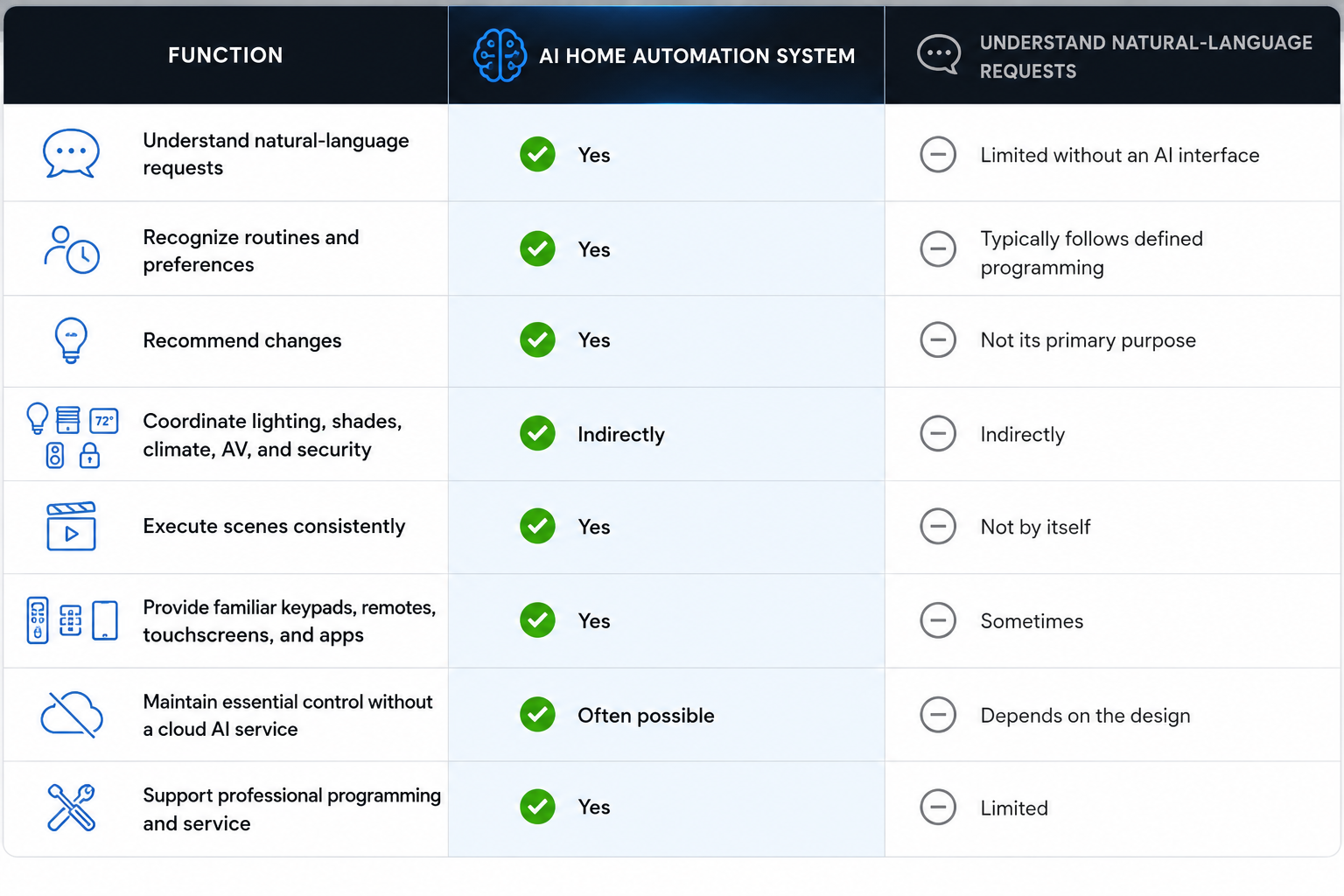
Not in the foreseeable future. AI is currently better understood as an increasingly intelligent interface to home technology. It can interpret natural language, simplify programming, recognize patterns, and eventually become more proactive, while connected systems still carry out actions throughout the home.
How is AI being used in smart homes today?
Current applications include natural-language voice control, conversational interfaces, scene creation, personalization, contextual commands, alerts, and assistance with controlling compatible devices. Platforms such as Josh.ai are already incorporating AI into whole-home control.
Could homeowners eventually program systems such as Control4 or Savant using AI?
That is a plausible near-term direction, although the level of homeowner access will depend on what each platform allows. AI could translate plain-English instructions into configuration changes, making routine adjustments easier without requiring homeowners to learn professional programming software.
Can AI control devices that are not smart?
Software-based AI generally requires an electronic means of controlling a device. It cannot physically operate a manual lock, faucet, window, or appliance by itself. Embodied AI could eventually change that by allowing an intelligent physical agent to interact with ordinary objects.
What is embodied AI?
Embodied AI combines artificial intelligence with a physical machine capable of sensing, moving through, and interacting with the real world. Humanoid robots being developed by companies such as Figure and 1X are current examples of research and commercialization moving in this direction.
Will AI eliminate the need for smart devices?
Probably not. Direct electronic communication will remain faster and more practical for many functions. A future home may instead use a combination of connected systems for tasks suited to electronic control and embodied AI for physical tasks where making every individual object smart provides little benefit.
Will AI require better home networks?
In the near term, generally yes. More intelligent homes depend on reliable communication among devices, processors, sensors, interfaces, and online services. The actual bandwidth required will depend on how much processing occurs locally, how efficiently information is compressed, and how future systems are designed.
Is privacy a concern with AI in the home?
Yes. AI systems using microphones, cameras, occupancy information, or behavioral patterns can have access to unusually personal information. Homeowners should understand what is collected, where processing occurs, how long information is retained, which services receive it, and what can be disabled.
How should I prepare a home for future AI technology?
Focus on fundamentals rather than trying to predict specific future products: reliable networking, appropriate wiring and conduit, controllable devices where they provide real value, flexible systems, local control for important functions, and deliberate privacy choices. Those decisions provide room for AI capabilities to evolve without designing the entire house around an uncertain prediction.
The distinction becomes clearer when their responsibilities are compared.