
Wireless vs. Wired Outdoor Speakers: Which System Is Right for Your Home?
Sonos, Coastal Source, Sonance, Origin Acoustics, and the Importance of Proper Outdoor Audio Design
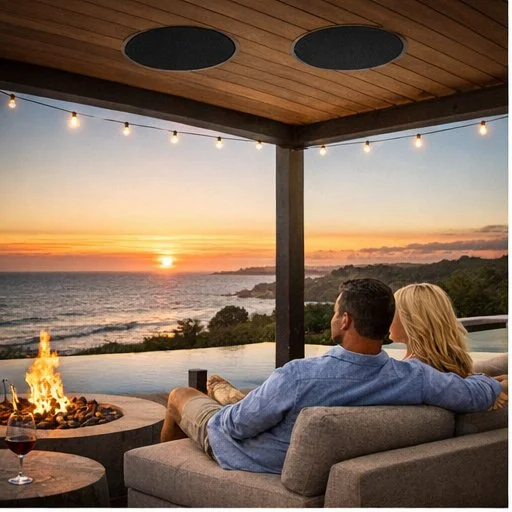
Outdoor audio speakers from Origin Acoustics
Outdoor audio should feel natural. Music should be evenly distributed across a patio, pool, terrace, or garden without visible equipment dominating the landscape—or one loud speaker disturbing everyone nearby.
Portable wireless speakers make it easy to bring music outside. But for larger properties and permanent outdoor living areas, a professionally designed wired system usually provides better coverage, stronger performance, and greater long-term reliability.
The right choice depends on how the space will be used, the size of the property, the available infrastructure, and how important sound quality is to the homeowner.
What Does “Wireless Outdoor Audio” Actually Mean?
The term “wireless speaker” can be misleading.
Portable products such as the Sonos Move 2 and Roam 2 receive music over Wi-Fi or Bluetooth and operate on rechargeable batteries. These are genuinely portable wireless speakers, although they still need to be charged.
Installed Sonos Outdoor Speakers by Sonance are different. Music selection and volume control are wireless through the Sonos app, but the speakers themselves are passive. They require speaker cable connected to a Sonos Amp, which also needs power and a reliable network connection.
In other words, many systems marketed as wireless still depend on wiring somewhere in the system.
When Portable Sonos Speakers Make Sense
Sonos Move 2 and Roam 2 are useful when flexibility matters more than permanent coverage.
They can be a good fit for:
A small patio or balcony
Occasional outdoor listening
Rental or seasonal properties where construction is undesirable
Homeowners who want to carry one speaker between spaces
Areas where speaker wiring cannot be installed yet
The Sonos ecosystem also makes it easy to group portable outdoor audio with compatible speakers inside the home. For casual listening, that simplicity is appealing.
The Weaknesses of Wireless Outdoor Speakers
Wireless outdoor speakers are convenient, but convenience comes with limitations.
Dependence on Outdoor Wi-Fi
A wireless speaker can only be as reliable as the network supporting it. Exterior walls, large glass doors, masonry, landscaping, detached structures, and the physical size of an estate can all affect Wi-Fi performance.
A speaker that works well near the house may become inconsistent by the pool, guesthouse, tennis court, or far side of the property. Bluetooth has an even shorter practical range and can be interrupted when the source device moves.
Outdoor Wi-Fi can be improved, but it must be designed as part of the property’s network rather than assumed to extend everywhere.
Batteries and Charging
Portable speakers need to be charged, carried outside, brought back in, and stored. That may be perfectly acceptable for occasional use, but it is less convenient when outdoor spaces are used every day. Not to mention, carrrying a tray of snacks and drinks and a speaker is cumbersome.
Battery capacity also declines over time. A permanent outdoor system avoids the ritual of checking whether the speakers are charged before guests arrive.
Uneven Sound Coverage
One portable speaker usually creates one loud area and several quiet ones. Turning it up enough to reach the far side of a patio can make the area closest to the speaker uncomfortable.
A distributed system uses several strategically placed speakers at lower volume. The result is more even, comfortable sound—and often less sound traveling toward neighboring properties.
Limited Bass and Scale
Compact wireless speakers can sound impressive for their size, but they cannot move air in the same way as a distributed landscape system with a dedicated outdoor subwoofer.
Open-air environments absorb sound differently from interior rooms. There are no walls or ceilings to reinforce bass, so larger spaces require thoughtful speaker placement, amplification, and low-frequency support.
Weather Exposure
“Water-resistant” and “weatherproof” do not always mean the same thing. Portable speakers may tolerate splashes or brief exposure, but they still need appropriate care and storage.
Permanently installed outdoor speakers should be selected for the property’s actual conditions, including rain, irrigation, humidity, salt air, temperature changes, and year-round exposure.
Dependence on Apps and Consumer Devices
Portable systems rely heavily on phones, apps, batteries, Wi-Fi, and software. Updates, account issues, changing network credentials, or a guest’s unfamiliarity with the system can interrupt an otherwise simple experience.
A well-designed permanent system can still offer app control while also integrating with a Savant or Control4 interface, keypads, and preset scenes.

Coastal Source outdoor speakers and lighting
The Advantages of a Wired Outdoor Audio System
For a permanent outdoor living area, wired audio remains the more predictable foundation.
A professionally designed system can provide:
Consistent sound across large or irregular spaces
Discreet speakers placed throughout the landscape
Stronger bass from concealed or partially buried subwoofers
Centralized amplification located safely indoors
Fewer batteries and devices exposed to the weather
Integration with indoor audio, lighting, television, and control systems
Independent zones for patios, pools, lawns, gardens, and guest areas
Better long-term serviceability
Wired does not mean difficult to use. The infrastructure can be wired while music selection and everyday control remain available through a phone, tablet, keypad, or home automation system.
The Limitations of Wired Outdoor Audio
A wired system also requires more planning.
Speaker cable must reach each listening area, and subwoofers, amplifiers, conduits, drainage conditions, and equipment locations need to be considered. Installation becomes more disruptive and expensive after finished patios, pools, retaining walls, and mature landscaping are already in place.
That is why outdoor audio should be discussed while a property is being built, renovated, or landscaped. Running conduit early preserves options—even if the complete audio system will be installed later.
Wired systems also require professional design. More speakers do not automatically create better sound. Speaker spacing, aiming, amplifier capacity, zoning, voltage drop, neighboring properties, and expected listening levels all affect the result.
Sonos Outdoor Speakers by Sonance
For patios and smaller outdoor zones, Sonos Outdoor Speakers by Sonance can provide a practical middle ground.
The speakers are permanently installed and connected by wire to a Sonos Amp, while homeowners retain familiar Sonos app control. This is often a good solution for a covered patio, terrace, outdoor kitchen, or defined entertaining area.
The limitation is scale. A pair of wall-mounted speakers may cover a compact patio well, but it is not the same as a distributed landscape system designed to cover a pool, lawn, dining area, and several seating zones.
Other Outdoor Audio Brands HTE Recommends
HTE does not force every property into one speaker platform. The recommendation should reflect the architecture, landscape, listening expectations, exposure conditions, and desired level of integration.
Coastal Source
Coastal Source is one of HTE’s leading recommendations for high-performance outdoor audio, particularly on coastal properties.
Its systems are engineered for demanding outdoor environments and can include discreet landscape speakers, bollard-style models, powerful subwoofers, and purpose-built cabling and connections. Coastal Source is especially appropriate when durability, strong musical performance, and long-term exposure to Hamptons conditions are major concerns.
Sonance
Sonance offers more than the Sonos-branded outdoor pair. Its landscape systems use multiple satellite speakers and outdoor subwoofers to distribute sound evenly across larger areas.
Sonance is a strong choice when speakers need to blend into plantings, hardscape, architecture, or other outdoor details without sacrificing coverage.
Origin Acoustics
Origin Acoustics offers weather-resistant surface-mounted, landscape, rock-style, and buried-subwoofer solutions. Its outdoor systems can be configured for patios as well as larger landscapes requiring multiple speakers and extended cable distances.
The range of form factors makes Origin useful when the design calls for a specific balance of visibility, placement flexibility, and performance.
James Loudspeaker
James Loudspeaker is often considered when performance must be combined with a carefully controlled form factor or finish. Its durable architectural products can be useful in outdoor spaces where speakers need to coordinate closely with the architecture rather than appear as separate accessories.
Wireless or Wired: A Simple Comparison
Swipe or scroll horizontally to view the complete comparison.
| Consideration | Portable Wireless Speakers | Professionally Wired Outdoor Audio |
|---|---|---|
| Best Application | Small spaces and occasional use | Permanent patios, pools, gardens, and larger properties |
| Installation | Minimal | Requires planning and cabling |
| Sound Coverage | Concentrated near each speaker | Distributed evenly across the space |
| Bass Performance | Limited by enclosure size | Can include dedicated outdoor subwoofers |
| Reliability | Dependent on batteries and wireless coverage | Consistent when properly designed |
| Appearance | Visible and moved as needed | Can be concealed within architecture and landscaping |
| Control | Phone, Wi-Fi, or Bluetooth | App, keypad, remote, or smart-home system |
| Expansion | Easy at a small scale | Better suited to multiple zones and large properties |
| Upfront Cost | Lower | Higher |
| Long-Term Convenience | Requires charging and placement | Always ready to use |
Can Sonos Be Part of a Larger Wired System?
Yes. Choosing professionally wired speakers does not necessarily mean giving up Sonos.
A Sonos Amp or Sonos Port can serve as a music source within a more substantial audio system. Depending on the project, Sonos may also be integrated alongside Savant, Control4, or another whole-home control platform.
This hybrid approach gives homeowners familiar streaming control while allowing HTE to use outdoor speakers, subwoofers, amplification, and zoning appropriate for the property.
The HTE Perspective
Sonos is a strong solution when simplicity, familiar control, and modest coverage are the priorities. Portable products such as Move 2 and Roam 2 work well for flexible, casual listening. Sonos Outdoor Speakers by Sonance are a sensible installed option for a defined patio or terrace.
For a large Hamptons property, pool environment, waterfront home, or outdoor space intended for frequent entertaining, HTE will often recommend a distributed wired system from Coastal Source, Sonance, Origin Acoustics, James Loudspeaker, or another carefully selected manufacturer.
The goal is not to specify the most equipment. It is to create even coverage at comfortable volume, preserve the landscape, withstand the environment, and make the system easy to use.
If you are building, renovating, or redesigning an outdoor space, involve the technology team before hardscape and landscaping are complete. Early coordination creates better speaker locations, cleaner wiring paths, and more options with less disruption.
Explore HTE outdoor living solutions or schedule an outdoor audio consultation.
SEE ALSO: Motorized Vs Battery-Powered Shades