
What’s New in Smart Home Automation and AI?
The smart home is becoming more intelligent—but the best homes still begin with thoughtful design.
For years, “smart home” has meant convenience: one app for the lights, one remote for the television, a button that sets the room for dinner, a keypad that turns the whole house off at night. Today, artificial intelligence is beginning to change what homeowners expect from their systems.
The new question is no longer simply, “Can my home be controlled from my phone?”
It is becoming: “Can my home understand what I want?”
That shift is already underway. Voice assistants are becoming more conversational. Lighting systems can respond to more natural requests. Energy systems are becoming smarter about when and how power is used. And home automation platforms are beginning to move from simple commands toward more contextual, personalized experiences.
Still, there is an important distinction: most smart homes today are not truly “agentic” in the futuristic sense. They are not independently making broad decisions throughout the home without structure or permission. The best systems are still designed, programmed, and supported by professionals. AI is becoming a powerful layer on top of that foundation—not a replacement for it.
At Home Technology Experts, we see this as a very good thing. The future of luxury home automation is not a house that does whatever it wants. It is a house that feels more intuitive, more responsive, and more effortless because the technology behind it has been carefully designed.
Control4: a strong foundation for whole-home intelligence
Control4 remains one of the most established whole-home automation platforms because it excels at unifying many systems into one experience. Lighting, audio, video, climate, security, shades, outdoor entertainment, and more can all be brought together into a single interface, with control from phones, touchscreens, remotes, keypads, and voice integrations. Control4 describes its platform as connecting a vast catalog of smart devices and replacing many separate apps with one personalized interface.
Where Control4 shines today is not necessarily in flashy generative AI. Its strength is orchestration. A properly designed Control4 system can make daily living feel simple: one scene for entertaining, one scene for bedtime, one button to shut down the house, one remote that controls a room instead of a pile of components.
That matters because a luxury smart home is rarely a collection of gadgets. It is an ecosystem. The lighting system has to talk to the shades. The theater has to work with the audio system. The network has to support everything quietly in the background. Control4 is built around that kind of unified experience, and its integrator model allows the system to be customized around how the homeowner actually lives. Control4 specifically notes that certified integrators personalize systems, scenes, automations, and schedules, and support the home after installation.
The AI angle for Control4
As of today, Control4 is best understood as a highly capable automation platform with intelligent scenes, schedules, triggers, voice control, remote access, and broad device integration. It is not yet a fully autonomous AI agent making open-ended decisions throughout the house.
But that is also why it is dependable.
The likely future for platforms like Control4 is deeper use of AI around setup, personalization, troubleshooting, predictive service, natural-language programming, and smarter homeowner interaction. Imagine asking, “Why is the outdoor TV not responding?” and having the system help narrow the issue. Or saying, “Make the house ready for a dinner party,” and having the system suggest or activate the right lighting, music, temperature, and shade settings based on your preferences.
The home will still need a professionally designed backbone. AI will simply make that backbone easier to use.
Savant: elegant control meets energy intelligence
Savant has long appealed to homeowners who want a polished, design-forward control experience. It brings together lighting, climate, music, video, and other systems into one refined interface. Savant’s current positioning also leans heavily into energy management, backup power, and circuit-level control, which is becoming one of the most important frontiers in smart home automation. Savant describes its home platform as automating lighting, music, and video while also offering a “backup plan” when power goes out.
That energy focus is important. The smart home is no longer just about convenience and entertainment. It is increasingly about resilience: keeping essential systems running, managing battery power, reducing peak utility costs, and making better use of solar, generator, or battery backup systems.
Savant says its power modules can fit into standard breaker panels to monitor and control individual circuits, with automation software and the Savant app helping homeowners continue normal life even when the grid is down.
The AI angle for Savant
Savant’s most compelling “intelligence” today is not necessarily conversational AI. It is system awareness—especially around energy. A Savant Power system can help a home understand what circuits matter most, what loads can be managed, and how to respond during outages or periods of high energy cost.
That is a different flavor of smart.
In the future, this category is likely to become more AI-driven. Smart homes will become better at forecasting energy use, prioritizing loads, adjusting climate and shade behavior, and making recommendations based on utility rates, weather, battery capacity, and homeowner preferences. Industry-wide, this trend is supported by the continued expansion of Matter and smart energy management features, including recent Matter updates focused on cameras, closures, and enhanced energy management.
For high-end homes, especially larger residences in the Hamptons, Manhattan, and other premium markets, energy intelligence may become just as important as entertainment or lighting control. A truly modern home should be beautiful, comfortable, and prepared.
Josh.ai: the clearest AI-first smart home experience
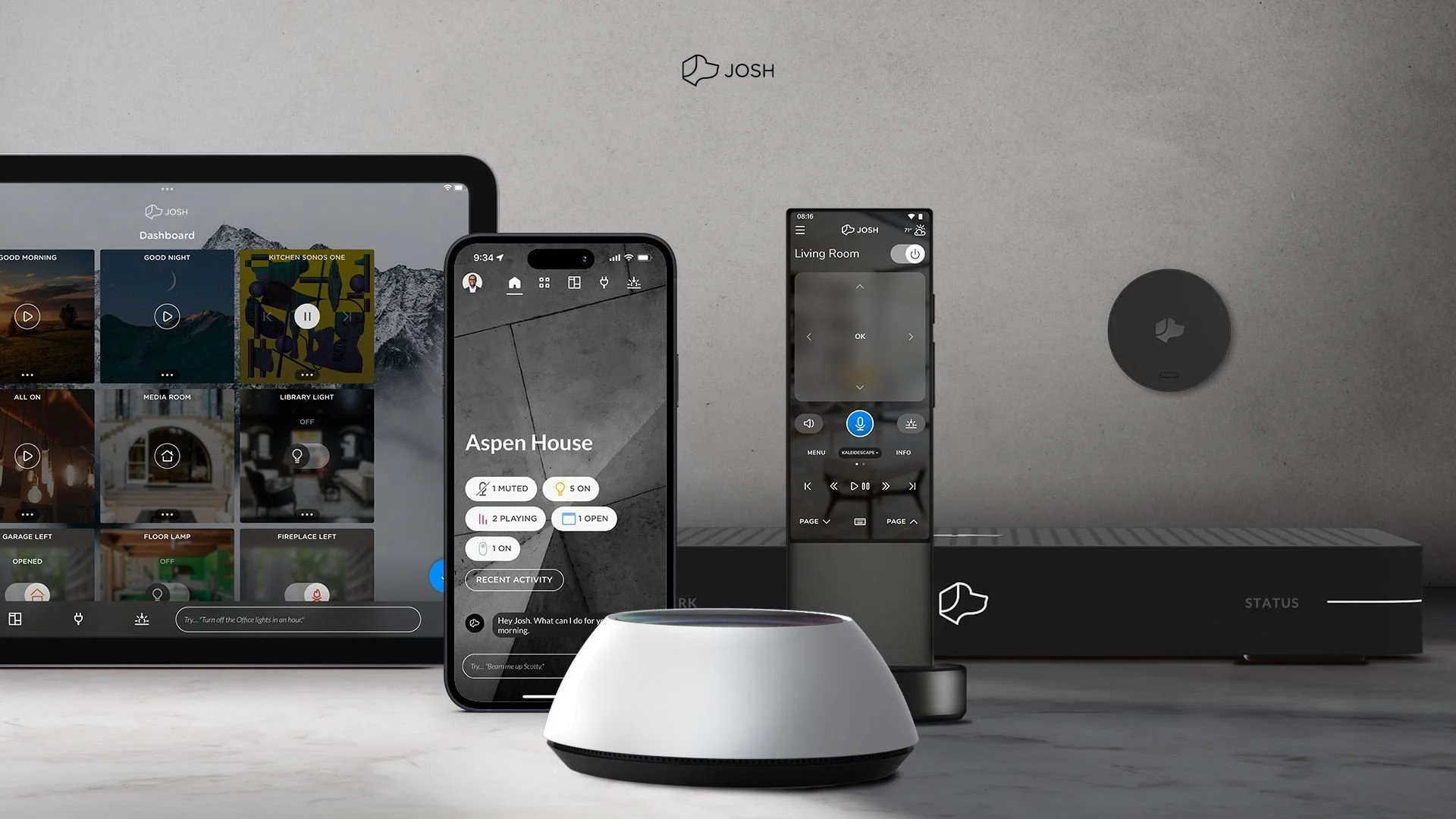
Of the three platforms, Josh.ai is the most directly associated with artificial intelligence and natural voice control. Josh was designed around the idea that a home should respond naturally through voice, touch, and intelligent interfaces. Josh.ai says its platform uses advanced AI technologies, including voice and touch, to orchestrate technology throughout the home.
Josh is especially interesting because it moves the user experience closer to how people actually speak. Instead of memorizing rigid commands, homeowners can ask for more natural outcomes. Josh.ai gives the example: “Play jazz, dim the lights and start the fireplace,” with connected devices working through a single interface.
That matters because voice control has always had a promise-and-friction problem. People love the idea of speaking to their home, but they do not want to remember exact device names, room labels, or robotic phrasing. AI helps bridge that gap.
Josh.ai’s JoshGPT takes that even further. It adds broader generative AI assistance around music, cooking, history, travel, entertainment, sports, local information, and lighting. One of the most relevant smart home examples is mood-based lighting: JoshGPT can interpret abstract prompts like making the lights feel like a Caribbean sunset or a storm rolling in, then translate those ideas into lighting colors.
The AI angle for Josh.ai
Josh is closest to what many homeowners imagine when they hear “AI smart home.” It understands more natural language, provides intelligent assistance, and can interpret context in ways that feel less mechanical than traditional command-based control.
That said, even Josh is not magic. It still depends on good system design, proper device integration, thoughtful naming, strong networking, and professional configuration. AI can only control what has been designed and connected correctly.
The best way to think about Josh.ai is as a more natural intelligence layer for the home. It does not replace the automation platform; it makes the home easier and more delightful to interact with.
What about Alexa, Google Gemini, Apple, and Matter?
The broader smart home world is moving quickly. Google has been rolling out Gemini for Home as a major AI upgrade to its smart home ecosystem, bringing more conversational, context-aware voice interaction to Google and Nest devices. Amazon has also been pushing Alexa Plus toward more natural language, complex commands, and conversational routine creation.
These developments are important because they reset homeowner expectations. People will increasingly expect their homes to understand conversational requests, not just exact commands.
Matter is also helping the industry move toward better interoperability. The Matter standard is designed to improve compatibility, security, and local control across smart home devices, and newer updates are expanding support for categories such as cameras, closures, and energy management.
For homeowners, this means more devices should eventually work together more gracefully. For luxury homes, however, “compatible” is not the same as “well-designed.” The difference between a collection of smart devices and a truly intelligent home is still the design, engineering, programming, and support behind the system.
Is today’s smart home truly agentic?
Not yet—not in the way people often imagine.
An agentic AI system can pursue goals, make plans, take actions, and adapt with limited human instruction. In a smart home, that might eventually mean a system that notices patterns, predicts needs, coordinates across subsystems, and asks for approval before making meaningful changes.
Today’s best smart homes are closer to structured intelligence. They use scenes, schedules, sensors, automations, voice control, and increasingly AI-enhanced interfaces. They can feel incredibly intuitive, but most of that experience is still intentionally designed.
That is a good thing. Homes are personal. They involve privacy, safety, comfort, security, and trust. We do not want a home making every decision on its own. We want a home that understands more, helps more, and stays firmly under the homeowner’s control.
What comes next?
The next wave of AI in smart home automation will likely focus on five areas.
First, voice control will become more conversational. Homeowners will speak more naturally and expect the system to understand intent, not just commands.
Second, lighting will become more adaptive. Instead of only selecting scenes, homeowners will ask for moods, moments, and outcomes: “Make the room feel calm,” “Set the patio for cocktails,” or “Help the kids wind down.”
Third, energy systems will become more proactive. Homes will become better at managing batteries, generators, solar, utility rates, and critical loads.
Fourth, service and support will become smarter. Systems may detect issues earlier, provide better diagnostics, and help integrators resolve problems faster.
Fifth, the interface will become less visible. The most sophisticated smart home will not feel like using technology at all. It will simply feel like the home is cooperating.
The HTE perspective: intelligence still needs expertise
AI is making smart homes more exciting, but it also makes planning more important.
A truly intelligent home needs a reliable network, thoughtful lighting control, properly designed audio and video systems, strong power management, clean documentation, and a support team that understands how all the pieces work together. HTE’s own project language describes the company as a full-service home technology integrator specializing in audio/video, automation, lighting controls, motorized shades, surveillance, access control, wired and wireless networks, and integration with gates, pools, security, HVAC, and more.
That is the real foundation of AI in the home.
Control4, Savant, and Josh.ai each bring something valuable to the conversation. Control4 offers powerful whole-home orchestration. Savant brings refined control with a growing emphasis on energy intelligence. Josh.ai delivers one of the most natural AI-driven control experiences available today.
The right choice depends on the home, the client, the desired experience, and the systems being integrated.
Our role is to make the technology feel simple—beautifully simple—while ensuring the design behind it is anything but accidental.
Ready to explore what an AI-enhanced smart home could feel like?
Whether you are building new, renovating, or upgrading an existing system, Home Technology Experts can help you design a home that feels intuitive today and is prepared for what comes next.
Luxury is simplicity. AI is just helping the home get better at delivering it.
Frequently Asked Questions About AI Smart Homes, Control4, Savant, and Josh.ai
What is an AI smart home?
An AI smart home uses artificial intelligence to make home technology feel more intuitive, responsive, and personalized. Instead of relying only on fixed commands or manual controls, AI-enhanced systems can better understand natural language, homeowner preferences, routines, and contextual requests.
Are today’s smart homes truly “agentic” AI systems?
Not yet. Most luxury smart homes today use structured automation rather than fully autonomous AI. Systems like Control4, Savant, and Josh.ai rely on professionally designed scenes, schedules, automations, and integrations. AI enhances the experience, but homeowners still remain in control.
What is the difference between home automation and AI?
Traditional home automation follows programmed rules and commands, such as turning lights on at sunset or activating a “Goodnight” scene. AI adds a more conversational and adaptive layer, helping systems understand intent, personalize experiences, and improve interaction through natural language and contextual awareness.
Which smart home platforms are leading the AI conversation?
Control4, Savant, and Josh.ai are among the most important platforms shaping luxury smart home experiences today. Each approaches intelligence differently:
Control4 focuses on unified whole-home orchestration
Savant emphasizes elegant control and energy intelligence
Josh.ai specializes in AI-driven voice interaction and natural language control
Is Control4 an AI platform?
Control4 is best understood as a powerful home automation platform rather than a fully AI-native system. Its strength lies in integrating lighting, climate, audio, video, security, shades, and other systems into one cohesive experience. AI capabilities are increasingly being layered on top through voice integrations, personalization, and smarter system interactions.
What makes Control4 popular in luxury homes?
Control4 is popular because it provides centralized control of many connected systems through one interface. Homeowners can manage lighting, entertainment, climate, security, and more from touchscreens, remotes, phones, keypads, and voice assistants. Its flexibility and professional customization make it especially effective for larger or more complex homes.
How does Savant differ from Control4?
Savant is known for its refined user experience and strong focus on energy management. In addition to lighting, entertainment, and climate control, Savant has invested heavily in intelligent power management, battery backup integration, solar optimization, and circuit-level energy monitoring.
Why is energy intelligence becoming important in smart homes?
Modern smart homes are increasingly expected to support resilience, sustainability, and energy efficiency. AI-enhanced energy systems can help homeowners manage generators, batteries, solar systems, utility costs, and critical power loads more intelligently—especially during outages or peak energy demand.
What is Josh.ai?
Josh.ai is an AI-focused smart home platform designed around natural voice control and intelligent interaction. It allows homeowners to speak more conversationally to their homes instead of relying on rigid commands or exact device names.
What makes Josh.ai different from Alexa or Google Assistant?
Josh.ai was built specifically for luxury home automation and professional integration. While platforms like Alexa and Google Assistant focus broadly on consumer smart devices, Josh.ai is designed to work closely with professionally installed systems and provide more advanced contextual understanding within the home environment.
What is JoshGPT?
JoshGPT is Josh.ai’s generative AI layer that expands beyond traditional smart home commands. It can assist with conversational requests related to lighting moods, music, entertainment, recipes, travel, and more. It helps create a more natural, human-like interaction with the home.
Can AI control lighting moods and scenes?
Yes. AI-enhanced lighting systems are beginning to support more abstract and mood-based requests. Instead of selecting a predefined scene manually, homeowners may say things like:
“Make the room feel relaxing”
“Set the patio for cocktails”
“Create a sunset atmosphere”
The system can then interpret and adjust lighting accordingly.
Does AI replace professional smart home design?
No. AI works best when built on a professionally designed foundation. Reliable networking, clean programming, proper device integration, lighting design, power management, and ongoing support remain essential for a smart home to perform consistently and securely.
What role does Matter play in the future of smart homes?
Matter is an industry standard designed to improve compatibility and interoperability between smart home devices. It helps devices from different manufacturers communicate more reliably and securely, making it easier for homeowners to build connected ecosystems.
Will smart homes become fully autonomous in the future?
The industry is gradually moving toward more adaptive and predictive systems, but fully autonomous homes are still far away. Most homeowners still want transparency, control, privacy, and approval over meaningful decisions. The future is likely to involve smarter assistance rather than complete independence.
What are the biggest AI trends in home automation right now?
Current trends include:
More conversational voice control
Smarter lighting personalization
AI-enhanced energy management
Predictive diagnostics and support
Simplified user interfaces
Improved interoperability between devices
Is AI smart home technology worth it for luxury homes?
For many luxury homeowners, AI-enhanced automation can improve comfort, convenience, energy management, and daily usability. The value often comes not from individual gadgets, but from how seamlessly the entire home works together.
How do I choose between Control4, Savant, and Josh.ai?
The right platform depends on the home, the systems being integrated, the desired user experience, and the homeowner’s priorities. Some clients prioritize whole-home orchestration, others prioritize energy intelligence or advanced voice interaction. A professional smart home integrator can help evaluate which platform best fits the project.
Why is professional integration important for smart homes?
Luxury smart homes involve many interconnected systems, including:
Professional integration ensures these systems work reliably together and remain easy to use over time.
Can an existing smart home be upgraded with AI features?
In many cases, yes. Existing smart home systems can often be enhanced with improved voice control, updated interfaces, energy management tools, and AI-driven integrations without completely rebuilding the system.
What should homeowners prioritize when planning a smart home?
Homeowners should prioritize:
A strong wired and wireless network
Scalable system architecture
Reliable integration platforms
Thoughtful lighting and entertainment design
Long-term support and service
Simplicity of daily use
The most successful smart homes feel effortless, not overly technical.