
Smart Home Automation · Intelligent Living · Home Technology Design
The Best Smart Home Ideas Are the Ones You Stop Thinking About
What living with home technology every day teaches us about designing better homes.
Imagine arriving home after dark.
You open the door and the house quietly responds. The lights come on at a comfortable level for the time of evening. The temperature has already begun adjusting. You do not reach for your phone, open an app, or think about which switch controls which light.
Later, friends arrive. One button near the entry prepares the house for entertaining. The lighting changes, music begins playing in the right rooms, exterior lights come on, and the home settles into an entirely different mood.
When everyone moves outside, the television, music, landscape lighting, and even the irrigation system know what is happening. The sprinklers will not suddenly interrupt the evening.
None of this is theoretical.
It is simply everyday life at the home of Brendan Dolan, a longtime member of the Home Technology Experts team.
And after years of designing, installing, programming, servicing, and living with home technology himself, Brendan has developed a fairly simple philosophy about what makes a smart home good.
The technology should make life easier.
Ideally, you should barely have to think about it at all.
Living With Technology Changes How You Design It
Brendan has been with Home Technology Experts since 2010.
He began as an installation helper and worked his way through nearly every part of the residential technology business, becoming a lead technician, service technician, project manager, designer, engineer, and eventually a manager in HTE's Hamptons office.
Along the way, his own home became something of a working laboratory.
Not because it is filled with technology for technology's sake, but because living with the same products and systems we recommend to clients provides a perspective that specification sheets cannot.
You learn what people actually use.
You learn which clever ideas become indispensable.
You also learn which ideas sounded brilliant when they were programmed but eventually become annoying enough that nobody uses them.
Most importantly, you learn that the person designing the system is rarely the only person living with it.
Brendan may understand everything happening behind the scenes. His family should not have to.
That distinction matters.
What Separates an Installer From an Integrator?
There is no shortage of technology available for the home today.
You can buy a television, speakers, thermostats, cameras, locks, lighting controls, doorbells, shades, and appliances that each come with their own app.
Installing those products is one thing.
Designing a home in which they work together naturally is something else. That is the purpose of professional smart home integration.
For Brendan, that begins long before anyone chooses equipment.
How does the family actually live?
Which rooms matter most?
Do they entertain often?
Do they listen to music throughout the house?
What happens when they arrive home at night?
Do they prefer an app, a remote, a keypad, voice control, or simply having things happen automatically?
Are there routines they repeat every day that could disappear entirely?
Those questions tell us far more about how a home should work than a list of products ever could.
A professional integrator should not simply connect technology. HTE also explains how an integrator differs from an equipment installer.
The job is to understand how someone wants to live, then make the technology support that experience.
The Best Automation Often Happens Without You
Ask Brendan about the automation he enjoys most in his home and he does not immediately point to a touchscreen or an elaborate command.
He talks about the things the house does when nobody asks it to.
"I think the stuff that happens when you do nothing is the coolest."
Brendan Dolan, Home Technology Experts
When someone arrives home in the evening, the lighting responds differently than it would during the middle of the day.
Before the family begins waking up, climate settings can adjust based on the season and conditions outside.
Later in the evening, thermostats begin transitioning toward comfortable sleeping temperatures.
At night, the home performs quiet checks to make sure garage doors are closed, exterior doors are locked, and outdoor lighting is where it should be.
Nobody has to remember any of this.
It simply happens.
That is when automation begins to feel less like operating a collection of smart devices and more like living in a thoughtfully designed home.
One Button Can Change the Entire House
Not everything should happen automatically.
Sometimes the best control is simply giving someone one obvious thing to do.
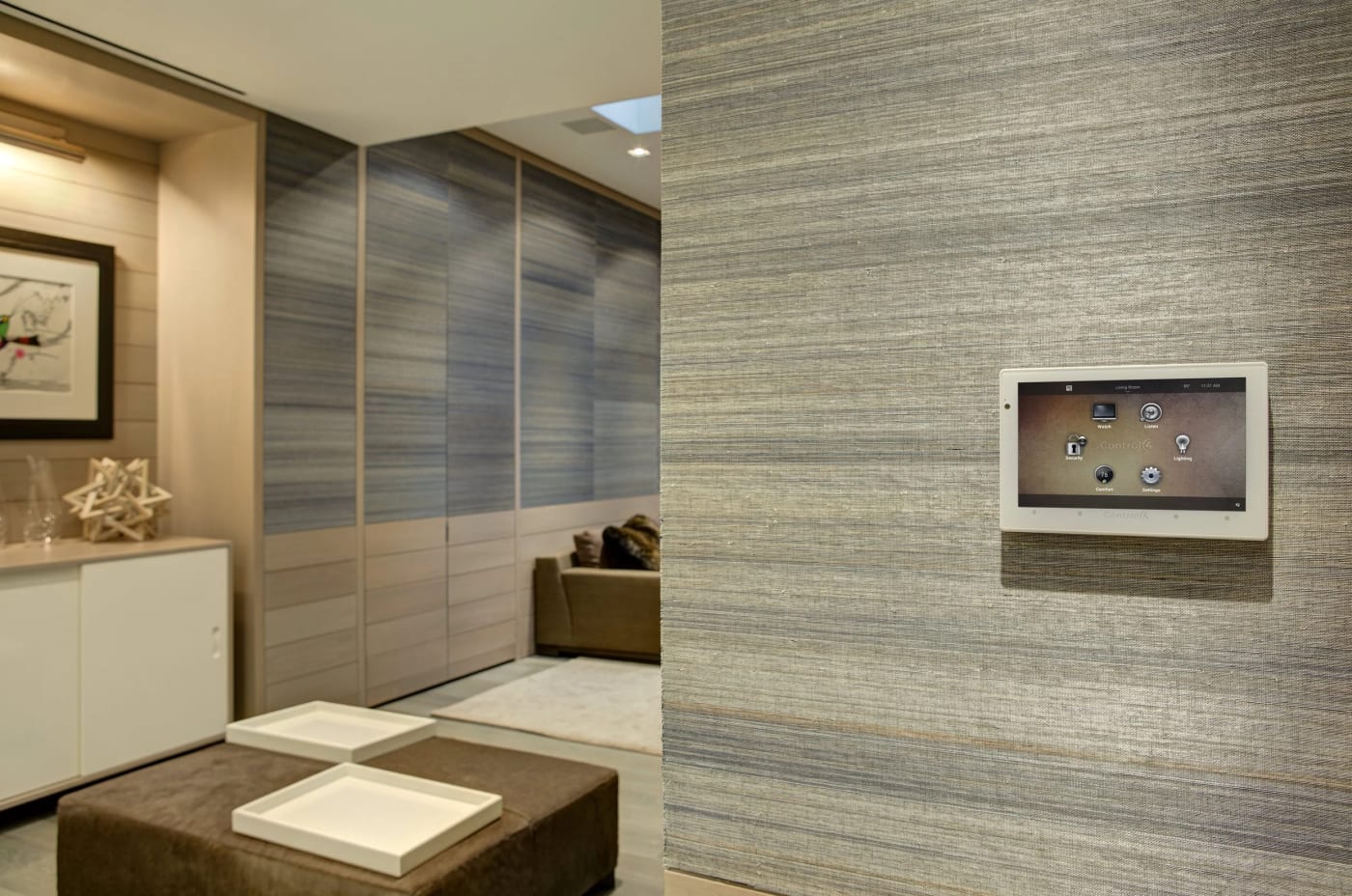
Near the foyer of Brendan's home is an Entertain button.
Press it and the house prepares for company.
Lighting shifts to a more inviting level, an example of what thoughtful lighting control can accomplish. Music begins playing throughout selected rooms at appropriate volumes. Exterior lighting comes on. The front door can be prepared for arriving guests.
Another command creates a Sports Mode.
The game appears on the television while its audio can be distributed to listening areas inside and outside. People can move around the house without feeling like they have left the game behind.
Even the irrigation system participates. If the backyard entertainment system is being used, the sprinklers know not to turn on.
None of these individual actions is especially remarkable on its own.
The value comes from connecting them around a real moment in someone's life. For more examples, see how a fully automated home organizes daily scenes.
That is the point.
A Smart Home Should Be Easy for Everyone
One of the easiest mistakes in home automation is designing the system around the person who understands it best.
Brendan's family is a constant reminder not to do that.
Different people naturally prefer different ways of interacting with technology.
Someone may enjoy using a mobile app.
Someone else may want a traditional handheld remote.
A child might stream music directly from a phone.
A guest should be able to walk into a room and understand how to turn on the television without being handed a tutorial.
Physical controls still matter.
Clearly labeled keypads, intuitive remotes, and permanent touchscreens can make a sophisticated home remarkably simple to use.
In several rooms of Brendan's house, physical keypads allow family members to start music, select favorites, and change the volume without reaching for a phone.
His rule is straightforward:
"If things aren't easy to use, then they don't get used at all."
Brendan Dolan, Home Technology Experts
The complexity belongs behind the scenes.
Smart Homes Do Not Have to Begin With New Construction
Brendan's home was not designed from the ground up as an automated house.
Like many homeowners, he purchased an existing home and improved it over time.
He ran wiring where it made sense, added infrastructure when opportunities arose, and expanded the system as his family's needs changed. This is particularly relevant to homeowners deciding when a smart home system should be planned.
That experience reinforces an important lesson for both renovations and new construction.
You do not necessarily have to purchase everything today.
But it is wise to prepare for tomorrow.
If walls are open, consider future speaker locations.
Run network wiring where it may eventually be needed.
Think about future televisions, access points, cameras, shades, outdoor entertainment, and equipment locations.
Install conduit where future access may be difficult.
Infrastructure is relatively inexpensive when a house is already under construction. Adding it after beautiful finishes are complete can be considerably more complicated.
Planning ahead gives a homeowner options.
And good technology design should always preserve options.
The System Should Feel Like One Home
Brendan's own house uses multiple technology platforms, including Control4 for home automation and Lutron for lighting control.
That is not unusual.
Different manufacturers are often exceptional at different things.
The homeowner, however, should not feel like they are operating several unrelated systems.
Press a lighting scene on a physical keypad and the rest of the home should understand what happened.
Activate that same scene from a touchscreen or remote and the result should feel identical.
The engineering behind that can be sophisticated.
The experience should not be.
That principle applies far beyond lighting.
Audio, video, climate, security, networking, shading, access control, and outdoor systems may come from different manufacturers, but a well-designed home should behave as one environment.
The homeowner should not have to think about which company made which piece of equipment.
They should simply interact with their home.
Security Can Become Part of the Experience
Cameras are another good example.
A security camera can certainly record video.
But when it participates in the larger home, it can do much more.
At Brendan's house, a vehicle entering the driveway can trigger a camera view on the home's touchscreens.
A package at the front door can create a notification.
Someone approaching the house at night can cause exterior lighting to respond.
When the doorbell rings, the family can see and speak with the visitor and, when appropriate, provide access.
The cameras are no longer isolated devices.
They become another source of information the home can respond to.
That is the difference integration makes.

The Network Is the Part You Should Rarely Notice
Behind all of this is something decidedly less glamorous.
The network.
Lighting controls, streaming music, televisions, touchscreens, cameras, doorbells, automation systems, mobile devices, and countless other technologies depend on it.
Brendan's home uses professionally designed networking equipment with indoor and outdoor Wi-Fi coverage.
He has also experimented with more advanced network configurations in his own home because doing so gives him firsthand experience that becomes useful on larger and more demanding projects.
For the homeowner, however, the goal is much simpler.
The network should work. HTE approaches home networking and Wi-Fi as the foundation of a dependable connected home.
A beautiful interface means very little if the infrastructure behind it is unreliable.
Some of the most important parts of a well-designed smart home are the parts nobody ever sees.
Convenience Should Not Mean Compromising Performance
Brendan also happens to love music and home theater.
His home has audio throughout the interior and outdoor spaces, multiple entertainment zones, and a basement room designed to serve both serious music listening and home theater.
What makes that room interesting is not the amount of equipment involved.
It is that the experience changes depending on what Brendan wants to do.
Watching a movie is one experience.
Sitting down to listen carefully to music is another.
The system reconfigures what needs to happen behind the scenes so the room can serve both purposes without turning each transition into a technical exercise.
That is a recurring theme throughout the house.
Complexity is acceptable behind the scenes when it creates simplicity in front of the homeowner.
Sometimes the Right Answer Is to Replace Something That Still Works
Living with technology over many years also gives you perspective on upgrades.
Homeowners understandably ask:
"Why do I need to replace this? It still works."
Sometimes they are absolutely right.
If a component continues to do its job reliably and does not limit the rest of the system, there may be no reason to replace it.
Other times, older equipment becomes the weak link.
A piece of video equipment may still display a picture but prevent a newer television from delivering everything it is capable of.
An older receiver may still produce sound while limiting newer audio or video formats.
A network component may function perfectly well for yesterday's demands but struggle with today's home.
Experience helps an integrator know the difference.
The goal should never be replacing equipment simply because something newer exists.
The goal is choosing equipment that allows the entire system to perform properly and explaining clearly why a change matters.
Brendan puts it another way:
"Don't make promises you can't keep."
Brendan Dolan, Home Technology Experts
Sometimes the best recommendation is knowing when not to force a workaround.
Living With It Reveals What Really Matters
Perhaps the greatest benefit of living with these systems every day is discovering which ideas survive beyond the demonstration.
A feature can look impressive when someone first sees it.
That does not mean it will improve their life six months later.
Families quickly reveal what works.
They gravitate toward the controls that feel natural.
They ignore the ones that require too much thought.
They appreciate the things the house quietly handles for them.
And they become frustrated by even small inconveniences when those inconveniences happen every day.
That experience has reinforced one of Brendan's most important design principles.
Do not program something simply because it is technically possible.
Do it because it makes the home easier, more comfortable, more enjoyable, or more secure.
Considering a smarter approach to your own home? A conversation about your daily routines is the right place to begin.
Discuss Your Smart Home PlansThe Best Technology Eventually Fades Into the Background
Brendan's house will probably never be completely finished.
There will always be another product to explore, another idea to test, or another way to make something work a little more naturally.
That curiosity is valuable.
But the lesson from all of that experimentation is surprisingly simple.
The products are not the goal.
The experience is.
Sometimes that experience is the lighting quietly responding when you arrive home.
Sometimes it is one button preparing the house for friends.
Sometimes it is a guest being able to turn on music or television without asking for instructions.
Sometimes it is simply making sure the sprinklers do not turn on while everyone is enjoying the backyard.
The measure of a great smart home is not how many things it can control.
It is how naturally the home responds to the people living in it.
Luxury is simplicity.
And sometimes the smartest technology is the technology you stop thinking about altogether.
Frequently Asked Questions About Everyday Smart Home Automation
What makes a smart home easy to use?
A useful smart home brings lighting, climate, audio, video and other systems together around everyday routines. Keypads, remotes and clearly designed scenes should make common activities simple for everyone in the household.
Can an existing home become a smart home?
Yes. Brendan developed his own system over time in an existing house. Thoughtful wiring, network improvements and phased upgrades can make a home easier to manage without rebuilding everything at once.
What is the difference between a smart home installer and an integrator?
An installer may handle a specific device or equipment task. An integrator designs how multiple systems communicate, are controlled, are tested and can be supported over time.
Why is home Wi-Fi important for automation?
Streaming, touchscreens, cameras, mobile controls and connected products all depend on reliable networking. Good coverage and wired infrastructure where appropriate help maintain a dependable experience.
Luxury is simplicity. We design home technology around how people actually live, then provide the support to keep it that way.
Schedule a Home Technology ConsultationOr call 631.446.1000.