
Whole-home audio | Home Technology Experts
Sonos vs. Bluesound vs. NAD: Which Whole-Home Audio System Fits Your Home?
A practical comparison of everyday convenience, sound quality, architectural speakers, equipment space, and smart-home integration.
The short answer: Sonos is a strong choice for familiar, straightforward multi-room music. Bluesound brings high-resolution streaming and an audio-focused approach to the same everyday experience. NAD offers additional BluOS-enabled amplification options for custom installations and serious listening spaces. The best choice depends less on the logo and more on your rooms, speakers, control preferences, and long-term plans.
Music should move naturally with you. A playlist in the kitchen can continue onto the terrace, while a favorite recording deserves a different level of attention in the living room. A well-designed whole-home audio system supports both experiences without asking everyone in the household to become an audio expert.
For homeowners comparing Sonos, Bluesound, and NAD, it helps to begin with an important distinction: these are three brands, but not three separate streaming ecosystems. Sonos has its own platform. Bluesound and select NAD components use BluOS, allowing compatible products to operate within one multi-room environment.
Sonos: A familiar way to enjoy music throughout the home
Sonos has earned its place in many homes by making music approachable. Its range includes wireless speakers, soundbars, subwoofers, and amplifiers that can power passive architectural speakers. That makes it suitable for a single room, a second residence, or a larger distributed-audio project.
For someone who already enjoys a Sonos system, keeping that experience can be an entirely sensible decision. Familiar controls have value, particularly in a home shared by family and guests.
The planning question is whether the chosen Sonos products offer the speaker connections, room groupings, input options, and third-party controls the project requires. A simple wireless-speaker setup and a fully integrated estate are different design assignments.
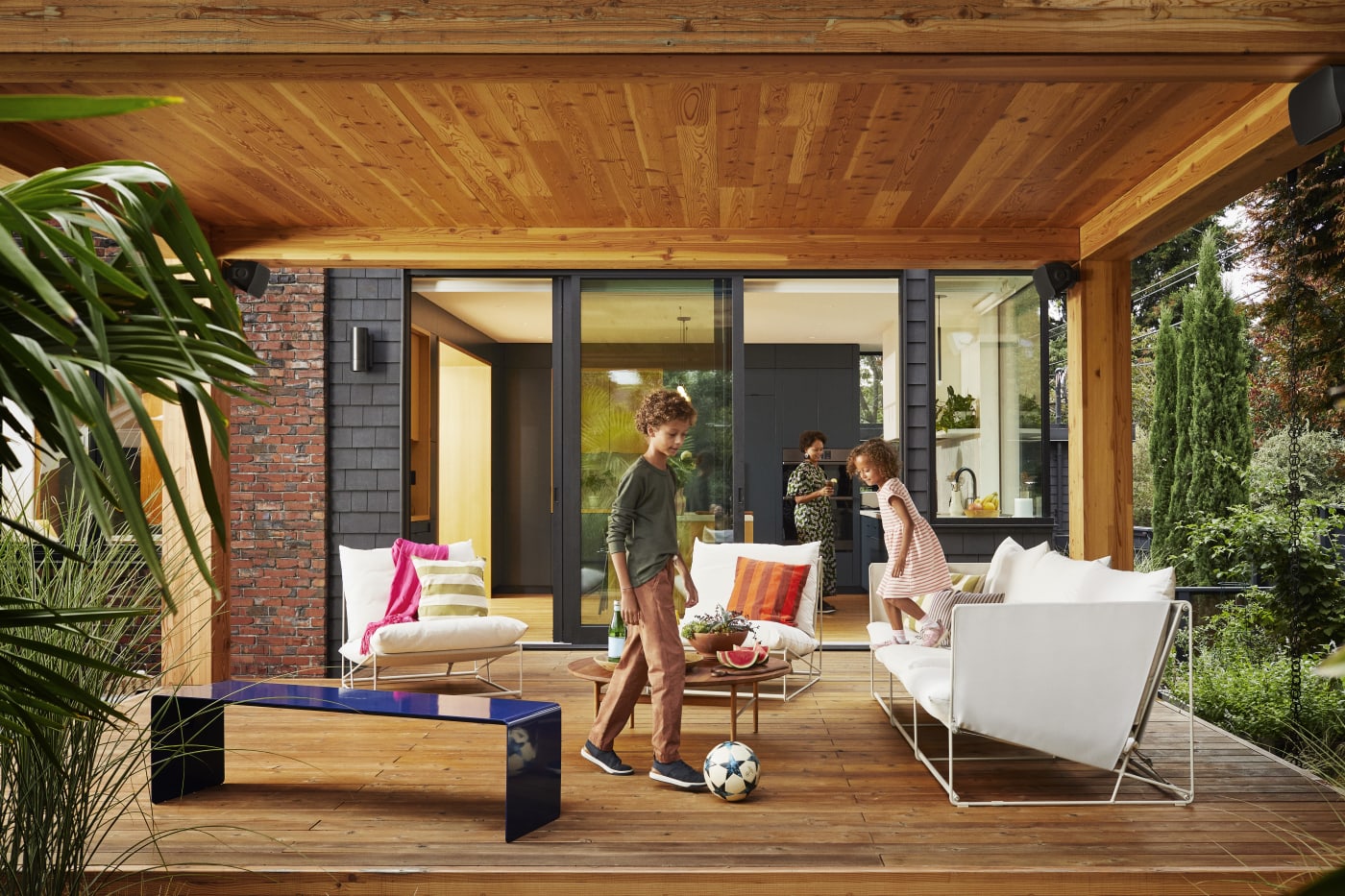
Bluesound: Multi-room convenience with an audio-focused approach
Bluesound is designed for listeners who want convenient streaming while placing particular importance on audio formats, components, and speaker performance. Its product family includes wireless speakers, streaming players, and amplifiers, all centered on the BluOS platform.
That does not mean Bluesound will automatically sound better than Sonos in every room. Speaker selection, placement, room acoustics, amplification, and the quality of the recording often matter more than a brand comparison alone. A busy kitchen and a dedicated listening room should not be judged by the same standard.
Where Bluesound becomes particularly interesting is the ability to combine approachable multi-room listening with thoughtfully selected speakers and electronics.
Does the music app still matter?
Yes, but it should not be the only deciding factor. Some listeners prefer the Sonos or BluOS app for browsing, grouping rooms, and managing playback. Others start with Spotify Connect or Apple AirPlay on compatible devices.
There is an important distinction: starting music from a familiar streaming service is not the same as having identical control of every zone. Grouping, queue management, sources, synchronization, and volume behavior can vary by platform, service, and model. Apple Music and AirPlay, for example, should not be treated as interchangeable with native in-app playback.
Before choosing a system, we recommend demonstrating the exact experience the homeowner will use: starting a playlist, moving it between rooms, grouping zones for a gathering, and letting someone else take over.
Where NAD fits into a BluOS whole-home audio system
NAD is best understood as a complementary component choice, not a third independent platform. Select NAD amplifiers and streaming components run BluOS, so they can join compatible Bluesound devices in the same ecosystem.
This is especially useful for homes with different listening priorities. One area may need compact, centralized amplification for architectural speakers. Another may deserve a more ambitious stereo system with dedicated loudspeakers.
Compact amplification when space matters
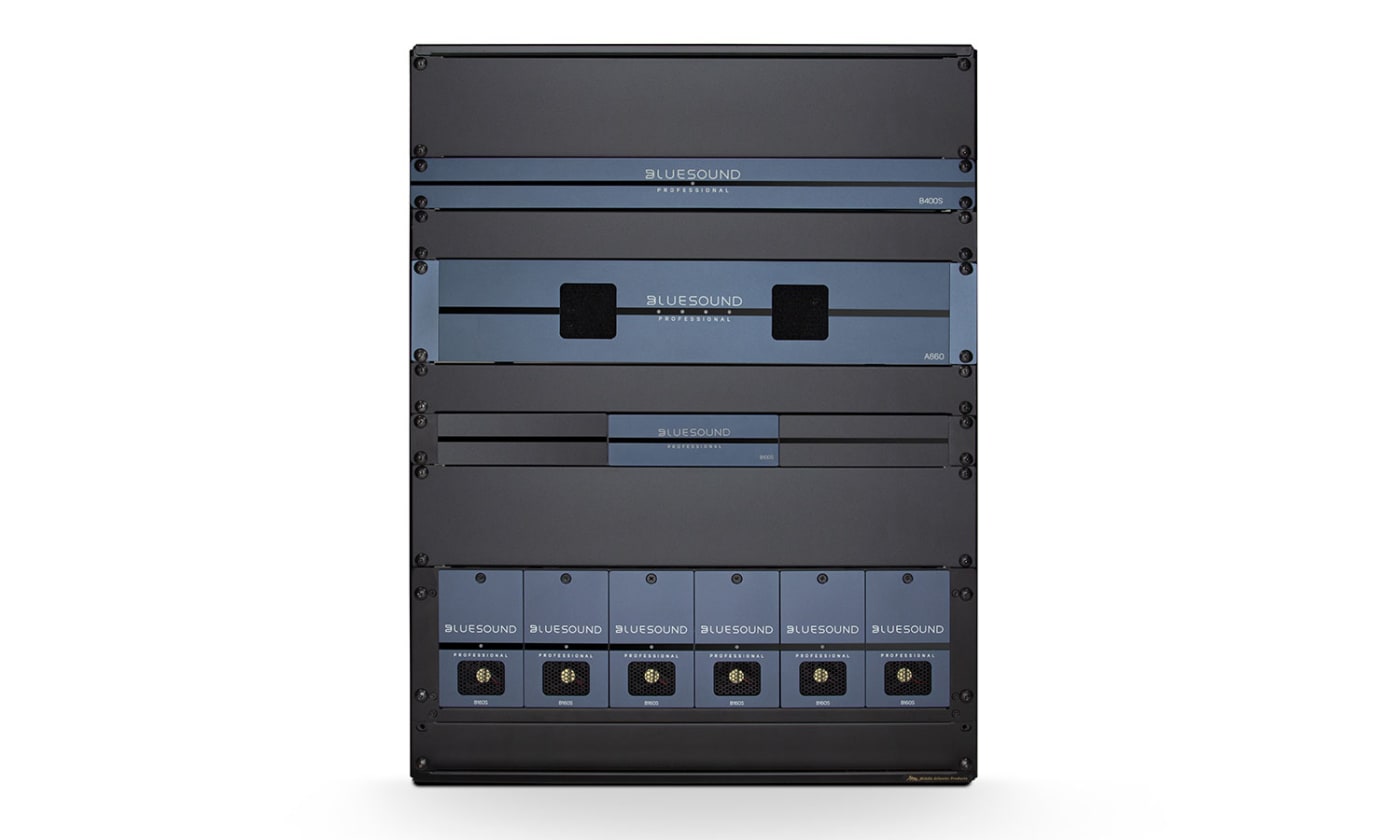
The NAD CI SA2-120 BluOS Streaming Amplifier Module is one example of equipment designed for professional installation. Each module can be configured for one or two zones, and its one-third-rack-width, 1U-high chassis is designed for efficient rack layouts. Three modules can occupy the width of a 1U rack space and, in dual-zone configurations, support up to six independent BluOS zones, subject to the complete system design.
For a Manhattan apartment, a carefully planned rack can preserve scarce storage space. In a larger Hamptons residence, it can help keep centralized equipment orderly and serviceable. Ventilation, speaker loads, wiring, and access still need to be engineered rather than inferred from a product's dimensions.
NAD Masters for rooms where music takes center stage
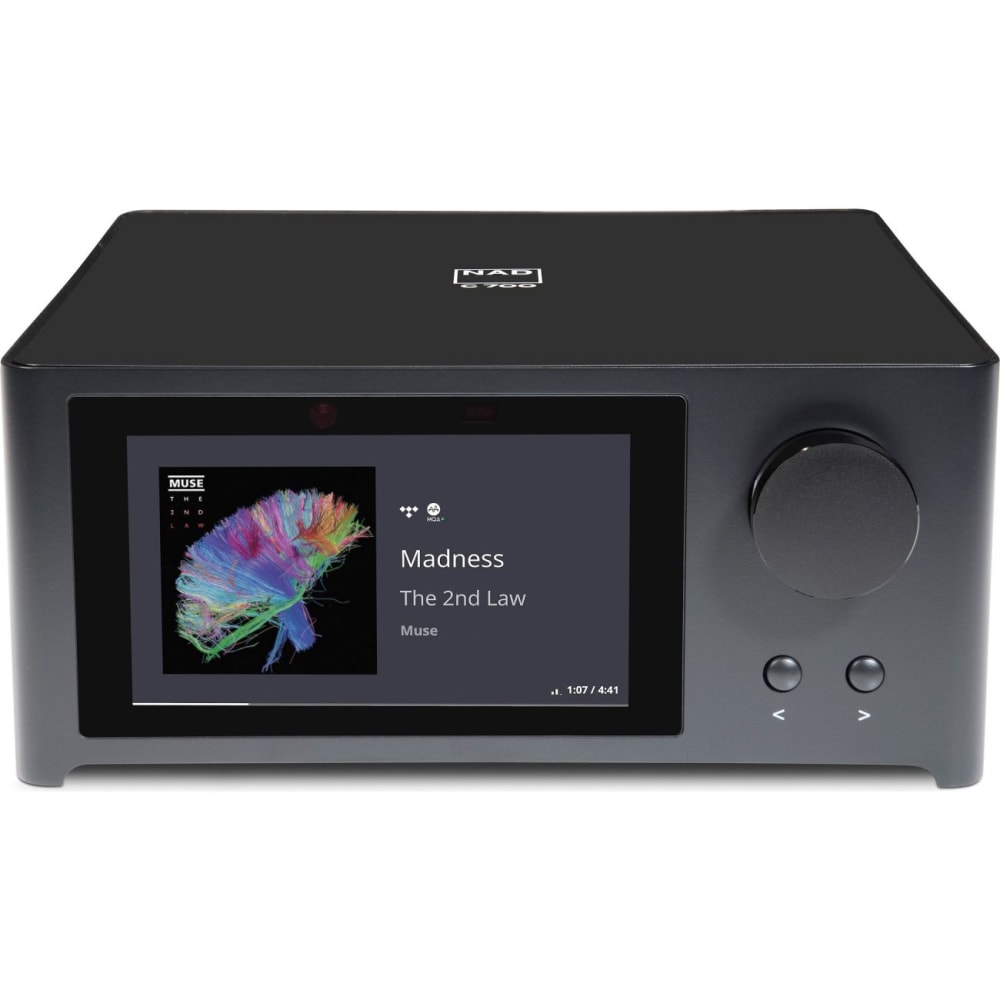
A living room or listening room may merit a more specialized solution than background music zones. BluOS-enabled NAD Masters products, such as the M10 V3 and M33 V2 integrated streaming amplifiers, offer another route to higher-performance stereo listening. The M66 streaming preamplifier can be paired with separate amplification where the design calls for it.
These products serve different needs and budgets, but compatible BluOS components can share a familiar music environment. A guest suite can remain simple while a primary listening room receives greater attention to speakers, acoustics, and amplification.
What about Control4, Savant, and the home network?
In a professionally integrated home, listening may also be part of a broader control experience. Depending on the products and supported drivers, audio can be accessed alongside television, lighting, shades, and other home functions through platforms such as whole-home control systems .
Neither Sonos nor BluOS should be assumed to offer identical functionality in every integration. Input selection, playlist access, grouping, feedback, and volume control must be checked against the specific devices, driver versions, and control platform. Reliable home networking is equally important for responsive streaming and control.
We prefer to test the intended use cases before committing to the equipment schedule, particularly for multi-property clients, outdoor zones, and homes with an existing system to preserve.
Sonos vs. Bluesound vs. NAD at a glance
| Consideration | Sonos | Bluesound | NAD with BluOS |
|---|---|---|---|
| Best suited to | Familiar multi-room listening and convenient expansion | Multi-room streaming with an audio-focused product range | Custom-install amplification and high-performance stereo rooms |
| Streaming ecosystem | Sonos | BluOS | BluOS on compatible NAD models |
| Typical components | Speakers, soundbars, subwoofers, amplifiers | Wireless speakers, streamers, amplifiers | Installation modules, integrated amps, preamplifiers |
| Key design question | How much does an existing, familiar experience matter? | Where do speakers and listening quality deserve added attention? | Which rooms need specialized or space-efficient amplification? |
| Integration | Confirm music-service features and third-party control at the exact model and driver level. | ||
This is a design comparison, not a claim that any platform will always outperform another. Available services and features differ by model, firmware, and region.
How we would choose for a real home
- Keep or expand Sonos when its familiar experience already works well and the proposed products meet the project's integration requirements.
- Consider Bluesound when the homeowner values streaming flexibility and plans to invest in better speakers or more attentive listening.
- Consider a Bluesound and NAD combination when different rooms require different levels of amplification, from discreet distributed audio to dedicated stereo performance.
- Design around the existing home when wiring, rack space, outdoor audio, acoustics, or control-system compatibility will shape the decision more than a feature list.
A thoughtful integrator also considers what happens after installation: system updates, replacement options, service access, and how easily the household can use the system years later. For a deeper look at design considerations, explore our approach to whole-home audio and video in the Hamptons and residential technology integration .
Ultimately, the right audio system is the one that makes music easy to enjoy in the rooms that matter to you, with the engineering quietly supporting the experience.
Luxury is simplicity.
Frequently asked questions about whole-home audio
Is Bluesound better than Sonos?
Not universally. Bluesound emphasizes high-resolution and audio-focused hardware, while Sonos offers an established, familiar multi-room experience. Speaker selection, room acoustics, and how the system is used are essential to the comparison.
Are Bluesound and NAD the same brand?
No. They are distinct brands within the Lenbrook family. Compatible products from each can use BluOS to participate in one multi-room streaming system.
Can I mix Sonos and BluOS in one house?
Yes, separate systems can coexist on an appropriately designed network, and selected third-party methods may provide some shared control. They should not be assumed to behave as one native synchronized platform. Confirm the desired experience before installation.
Can Sonos or BluOS integrate with Control4 or Savant?
Integration options depend on the product, control platform, driver, and supported functions. Your integrator should verify the desired control experience rather than relying on a general compatibility claim.
Do I need to replace an existing Sonos system?
Not necessarily. If it already serves the household well, retaining it may be the most practical and considerate solution. Any upgrade should solve a specific listening, reliability, or integration need.
Manufacturer references: NAD CI SA2-120 , NAD M10 V3 , NAD M33 V2 , and BluOS AirPlay compatibility . Confirm model specifications and availability when planning a project.
Plan audio around the way you live
From a discreet apartment system to music throughout a Hamptons estate, Home Technology Experts can help you choose the right experience for each room.
Discuss Your Home Audio Project