
Lighting from the Inside Out and the Outside In
By Rhys Wescott
How Interior and Exterior Lighting Scenes Create One Complete Experience
During the day, sunlight reveals nearly everything about a property. At night, darkness gives us a blank canvas and the freedom to decide what deserves attention, what remains in shadow, and where the eye travels.
A specimen tree emerges from the darkness, grazing light reveals the texture of a stone wall, and branches cast intricate shadows across the lawn. We can leave dead limbs and unattractive plantings unlit while illuminating distant trees to give the property an almost infinite sense of depth. A softly lit garden bench or dining table draws people in, creating inviting places to gather after sunset.
The results of thoughtful landscape lighting are immediately apparent. Less obvious are the decisions about how those lights are controlled, how those decisions influence the design, and what becomes possible when exterior lighting is coordinated with the rest of the home.
How Lighting Design and Control Influence Each Other
Interior fixtures commonly support dimming and, with compatible equipment, changes in color temperature. Most conventional landscape fixtures operate at fixed brightness and color temperature, with their effect established through fixture selection, placement, and aiming. Exterior lighting scenes therefore tend to control which zones are illuminated, while interior scenes can make additional adjustments.
These limitations make exterior fixture grouping and control especially important. A landscape lighting designer creates a composition by uplighting trees, accenting architectural features, and illuminating pathways and outdoor living areas. Since each serves a particular purpose, they should not operate on one switch.
Placing fixtures on separate circuits gives the homeowner flexibility. Pathway and step lighting can remain illuminated after decorative landscape lighting has switched off if they are circuited separately. Bistro lights over a dining area might be placed on their own dimmable circuit, allowing their brightness to change throughout the evening: softer during a meal, then briefly brighter for cleanup. The lights on the large oak in the back probably do not need that capability.
Newer outdoor lighting technologies, including Coastal Source VIA, offer more control over brightness, color temperature, and color. Beyond changing the mood for a party, these capabilities allow the lighting design to respond to the landscape as it changes throughout the year.
In spring, flowering trees and shrubs introduce colors that disappear as summer foliage takes over. Autumn brings reds, oranges, and golds, while winter reveals the branching structure of trees hidden beneath dense canopies. By adjusting the color and intensity of selected fixtures, and changing which areas receive emphasis, the designer can create compositions for each season.
With appropriate fixture selection and control zoning, these arrangements can be saved as seasonal lighting scenes. The lighting can evolve with the property, highlighting different plantings, colors, and architectural features throughout the year. That same flexibility also opens possibilities for holidays and special occasions, while pathways retain their familiar warm-white illumination.
When connected to a home automation system such as Control4 or Savant, these scenes can extend beyond the lighting. A party scene might coordinate colored accents in the garden with interior lighting, dim the bistro lights, and start music through the outdoor speakers. When the evening ends, the property can return to its usual lighting arrangement with a single command.
Everyday Landscape Lighting Control
A basic installation might use a switch connected to the transformer, requiring someone to turn the lighting on and off manually. Integrated timers eliminate that daily task, although fixed schedules need periodic adjustment.
On Long Island, sunset shifts by approximately four hours between winter and summer. A timer set to turn on landscape lights at 4:30 p.m. might be appropriate in December but not June. We have walked properties where the landscape lights are operating in broad daylight, often because a conventional timer was programmed once and never adjusted. The additional electricity cost generally is not the homeowner's primary concern, but unnecessary operating hours contribute to lamp and fixture wear and make the property look neglected.
Photosensors measure available daylight and activate the lighting when it becomes dark. They can work well, but vegetation growing around the sensor or debris covering it may cause the lights to turn on unexpectedly or stay on continuously. An astronomical timer instead calculates sunrise and sunset based on the date and property location, automatically accommodating seasonal changes.
A dedicated lighting control system introduces more flexibility in how the property is managed. Lutron Caséta, RadioRA 3, and HomeWorks offer different levels of scheduling, scene control, and access through compatible keypads and mobile applications. They also allow homeowners to override normal schedules without reprogramming individual timers. That remote access is particularly useful for seasonal homes: you may turn on driveway lighting for arriving guests, illuminate a service entrance for maintenance personnel, or check the lighting status while away.
Connecting Interior and Exterior Spaces
Architects designing custom homes devote considerable attention to orientation, sightlines, and how windows frame views of the surrounding landscape. Landscape architects consider those same views when positioning trees, gardens, sculpture, and hardscape features.
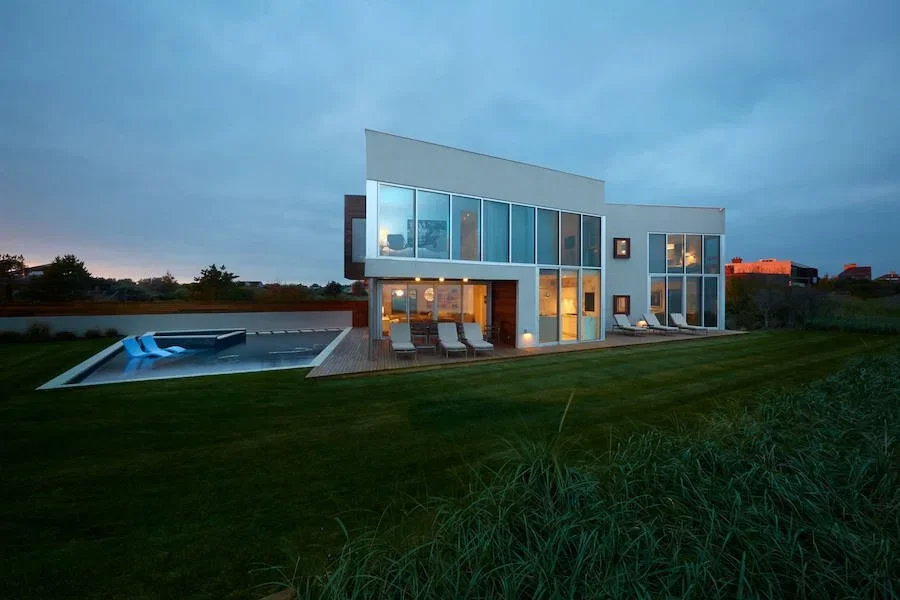
After dark, the view from inside the house depends as much on exterior lighting as on the landscape itself. A tree or sculpture that disappears into darkness can remain a focal point through the window when it is carefully illuminated. The garden outside the dining room window does not need to disappear at night. With thoughtful landscape lighting design, it can take on a different life after sunset.
That view can also be compromised by the home's own lighting. A brightly illuminated room creates reflections in the glass that obscure the landscape, even when exterior lighting has been carefully designed. Coordinated controls make it possible to manage both environments together, creating comfortable interior levels that enhance the view framed by the windows.
Imagine dinner with friends in a room overlooking the garden. As everyone gathers, you press a single keypad button and leave the lighting alone for the rest of the evening. As daylight fades, the interior lighting gradually becomes warmer and softer. Outside, the landscape lighting comes on just before sunset. By the time dessert is served, reflections in the windows have diminished and the illuminated garden has become an entirely different view.
Behind the scenes, a system such as Lutron HomeWorks can manage both environments. Inside, compatible Ketra or Rania fixtures can follow the progression of daylight. Outside, landscape lighting can follow an astronomical schedule programmed to activate before sunset. As sunset shifts throughout the year, the system adjusts accordingly. Nobody has to interrupt dinner to adjust a dimmer, select another scene, or remember to turn on the garden lights.
Bringing Modern Lighting Control to an Existing Home
The lighting experience described above is not reserved for new construction. Existing homes can benefit from many of the same technologies, often without extensive changes to the electrical infrastructure. The options depend on how the home is currently wired, the fixtures already installed, and how much flexibility the homeowner wants.
One of the simplest improvements is replacing conventional lighting with warm-dim LED fixtures. Unlike standard LEDs that maintain the same color temperature as they are dimmed, warm-dim lighting becomes warmer as its brightness decreases, similar to traditional incandescent bulbs. Compatible retrofit fixtures and lamps can often operate with existing dimmers.
For coordinated lighting scenes, scheduling, and automation, Lutron RadioRA 3 provides a wireless retrofit solution. Existing wall switches and dimmers can be replaced with compatible wireless controls that communicate without dedicated control wiring throughout the house. Keypads provide convenient access to scenes, while compatible downlights and tape lighting introduce tunable-white capabilities.
HomeWorks QSX offers greater flexibility and can also be installed using wireless dimmers, switches, keypads, and intelligent lighting fixtures. Larger homes may already have panelized lighting systems, with dimming and switching equipment in centralized electrical panels rather than behind individual wall switches. Existing HomeWorks panelized systems can often be upgraded, retaining much of their original wiring and, depending on the system, portions of the panel equipment.
HomeWorks can combine panelized and wireless controls within the same property, which is useful during a partial renovation. Existing panelized control may remain in service through most of the house while new wireless controls and intelligent fixtures are introduced into selected rooms. Landscape lighting can be incorporated into these upgrades as well, following astronomical schedules and participating in coordinated scenes. Independent control still depends on how the landscape lighting was originally circuited.
A Renovation That Connects the Whole Property
We are currently working on a home renovation that includes substantial changes to the main living spaces and an entirely new landscape design. The house has expansive windows overlooking the grounds, a clean modern design, and a cedar exterior. Much of the original lighting and shade equipment, however, detracts from the clean architectural lines and offers little flexibility in how the homeowners use their spaces.
The original five-inch, non-dimmable LED downlights are being replaced with two-inch Lutron Rania tunable-white fixtures. Mud-in flangeless trims in the sheetrock ceilings and flangeless trims designed for the living room's millwork ceiling will make the fixtures far less conspicuous. Through Lutron HomeWorks, the new lighting can follow the natural progression of daylight. Nearly every room will receive Rania, with Lutron Lumaris tunable-white lighting specified for the garage as a more economical alternative.
For the large windows around the living area, original line-voltage shades and exposed motors are being replaced with a low-voltage system. Most rollers will be concealed in architectural pockets, while locations that require exposed hardware will receive Lutron Palladiom shades. These blackout shades will provide privacy and protect furnishings and artwork from sunlight when the property is unoccupied.
The homeowner enjoys Formula 1 and European football, much of which is broadcast in New York during the morning and early afternoon. Even with a bright television, direct sunlight and reflections can interfere with viewing. A small Control4 system will manage the television and audio while coordinating appropriate lighting and shade scenes through Lutron HomeWorks. A dedicated viewing scene can position the shades and adjust the interior lighting for a more comfortable experience.
At the main entrance, multiple banks of blank switches are being replaced with three HomeWorks wireless engraved keypads in a single three-gang location. The homeowners will have access to coordinated lighting and shade scenes without the visual clutter of conventional switch banks.
Throughout the renovation, HTE is coordinating with the builder, architect, electrician, and landscape team to integrate lighting, shade pockets, and controls while preserving architectural details. Hamptons Landscape Lighting, a subsidiary of Home Technology Experts, is designing and installing the landscape lighting. Coordination lets fixture placement and wiring be planned around the new plantings and hardscape.
The landscape lighting will connect to the home's HomeWorks system, using its astronomical clock to activate before sunset and adjust automatically throughout the year. It will also be available through programmed scenes, giving the homeowners control over different areas of the property without managing individual timers or switches. Architectural exterior fixtures are being updated to complement the cedar facade, and bistro lights above the outdoor dining area will have their own inline dimmer to soften the light during dinner or brighten it afterward without affecting the surrounding landscape.
Planning for New Construction
In new construction, interior and exterior lighting frequently develop at different stages of the design process. The architect, electrician, or interior lighting designer may establish the architectural lighting plan while the home itself is being designed. Exterior sconces, recessed lighting in covered terraces, security fixtures, and some hardscape lighting may also be included at this stage.
The detailed landscape plan may not yet exist. Trees may not have been selected, planting beds are still being developed, and the locations of sculpture or other focal points may remain undecided. As the landscape design progresses, the exterior lighting designer can plan fixture placement and establish the zones needed to support the intended nighttime composition.
Coordination with the architect, landscape designer, electrician, builder, and technology integrator allows transformer locations, conduit routes, electrical requirements, and lighting controls to be considered before finished hardscape makes changes more difficult. If the home will include a whole-home lighting control system, the design team can anticipate exterior lighting requirements before final landscape fixtures have been selected.
Where to Begin
Whether you are planning a new home or improving an existing one, thoughtful lighting design begins with understanding how you want to experience the property. Interior lighting, landscape lighting, motorized shades, and their controls should be considered together, rather than as separate systems designed around individual products.
Our process begins with a consultation. We discuss how you use the home, what you would like to improve, and how lighting can complement the architecture and surrounding landscape. For an existing property, we evaluate the current systems to determine what can be retained, upgraded, or replaced. For new construction, we review architectural and landscape plans and identify opportunities before construction decisions limit the available options.
Home Technology Experts specializes in interior lighting control, motorized shades, and home automation, while Hamptons Landscape Lighting provides landscape lighting design and installation. Together, the teams can coordinate lighting throughout the property so it responds naturally to changing daylight, supports the way the home is used, and remains simple to operate.
Plan Your Lighting and Control SystemFrequently Asked Questions
Can existing landscape lighting be added to a whole-home control system?
Often, yes. Existing fixtures and transformers may be retained with appropriate control equipment. How independently areas can be controlled depends on the original circuits and transformer layout.
Why use an astronomical timer for exterior lighting?
It calculates sunrise and sunset based on the property location and date, so exterior lighting adjusts as seasons change without regular manual updates.
Can lighting scenes coordinate shades and entertainment?
With compatible systems, a scene can coordinate lighting, shades, audio, video, and other relevant systems. The result should be a simple, clear control experience rather than more technology to manage.
Related reading: Explore lighting control for Hamptons homes, smart home integration, whole-home AV integration, and automation for coastal homes.