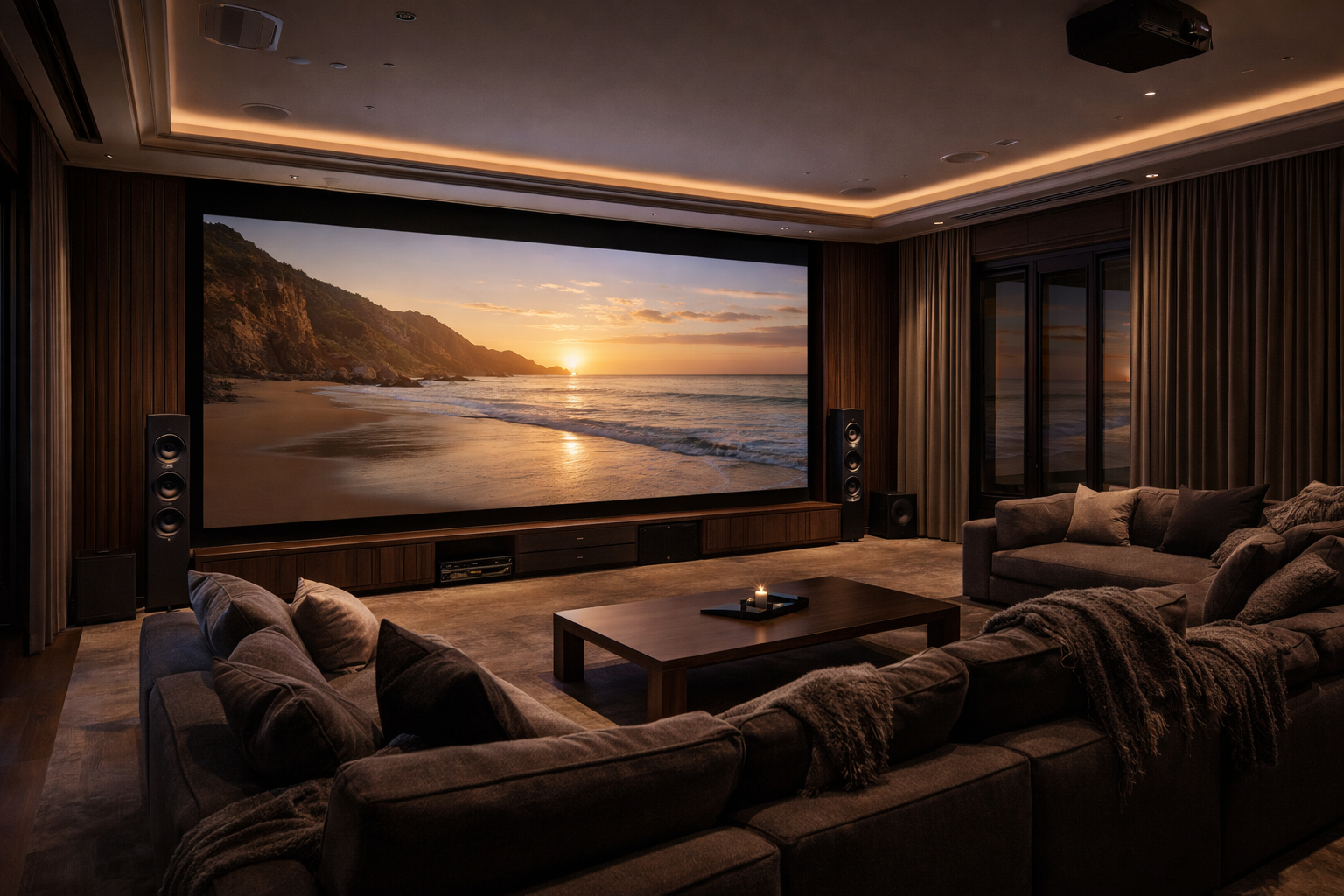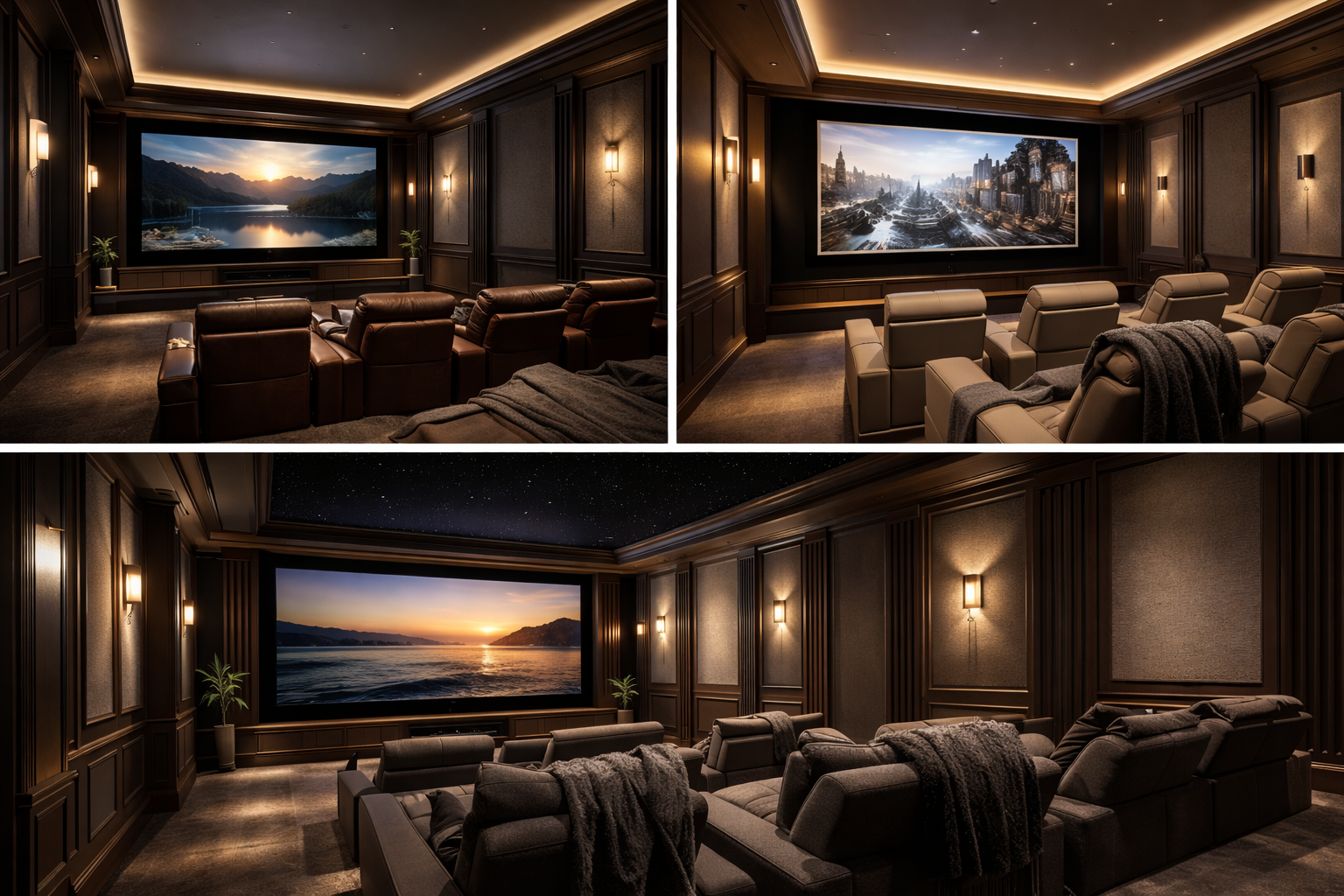
What Defines a High-Performance Private Cinema?
A truly exceptional private cinema is not simply a room with a large screen and powerful speakers. It is a carefully engineered environment where picture, sound, acoustics, architecture, and intuitive control work together to create an immersive experience.
There is a meaningful difference between an impressive home theater and a high-performance private cinema.
Both may feature a beautiful screen, immersive audio, and comfortable seating. But a truly high-performance cinema is designed to deliver consistent visual and acoustic performance throughout the viewing experience.
Dialogue remains clear. Sound moves convincingly around the room. Dark scenes retain detail. The image feels appropriately scaled to the seating distance. Reflections, unwanted noise, and distracting light are controlled.
Most importantly, none of this requires the homeowner to manage a complicated collection of equipment.
The experience should feel effortless. The engineering behind it may be anything but.
What Makes a Private Cinema High Performance?
High performance is best understood as the result of several design disciplines working together.
Image brightness, contrast, color, and scale are matched to the room and viewing positions.
Dialogue, music, effects, and bass are reproduced with clarity, balance, and appropriate impact.
Light, reflections, room acoustics, mechanical noise, and distractions are deliberately managed.
These characteristics require more than selecting excellent components. They require a coordinated design process, precise installation, measurement, and final calibration.
The Room Is Designed as Part of the System
In a private cinema, the room itself influences nearly every aspect of performance.
Its dimensions affect acoustic behavior. Ceiling height influences speaker placement. Wall and ceiling finishes affect reflections. Doors, windows, and construction details determine how much unwanted light and sound enter the space.
A high-performance cinema should therefore begin with the physical environment, not an equipment shopping list.
Early planning evaluates:
- Room dimensions and proportions.
- Primary and secondary seating positions.
- Screen size and viewing geometry.
- Speaker and subwoofer locations.
- Sound isolation requirements.
- Acoustic treatment and finish materials.
- Lighting control and equipment ventilation.
- Access for installation, service, and future adjustments.
In a new Hamptons residence, these decisions can be integrated during architectural planning. In an existing Manhattan or Long Island home, the same principles apply, although structural and space constraints may require a different approach.
Defining principle: A private cinema should be designed as one complete environment. The room is not merely a place to put the equipment.
The Image Is Accurate, Immersive, and Properly Scaled
A high-performance cinema image should convey the intention of the content without becoming visually exhausting.
Screen size matters, but bigger is not automatically better.
The ideal image depends on seating distance, viewing angles, screen format, room lighting, and the characteristics of the selected display technology.
Projection or Direct-View Display?
Premium laser projection remains an excellent option for dedicated dark-room environments, particularly when a large cinematic image and an acoustically transparent screen are priorities.
High-end direct-view technologies, including modular LED displays, may offer benefits in brightness and contrast, although their installation, viewing distance, surface characteristics, and audio integration require careful evaluation.
Neither technology guarantees a superior experience in every room.
Contrast and Black-Level Performance
Deep blacks and preserved shadow detail are essential to cinematic realism.
A bright image can still appear flat if black levels are compromised or reflected light reduces perceived contrast.
For projection, controlling light reflected from walls, ceilings, furnishings, and other surfaces is particularly important.
Color Accuracy and HDR
A high-performance system should reproduce color naturally and handle high dynamic range content within the capabilities of the chosen display.
The correct result is not necessarily the most saturated or brightest picture.
It is a balanced image that preserves intended detail, realistic color, and appropriate tonal relationships.
Professional Video Processing
Some installations benefit from dedicated video processing to optimize tone mapping, aspect ratio handling, scaling, or other image characteristics.
The value comes from improving the image actually displayed, not simply adding another processor to the equipment rack.
Defining principle: Reference-quality video is about accurate, consistent image reproduction at the intended viewing positions, not maximum screen size or brightness.
Immersive Audio Is Engineered Around the Seating
Great cinema sound should create a convincing sense of space.
Dialogue belongs naturally to the screen. Music feels cohesive. Effects move through the environment with appropriate direction and scale. Bass contributes impact without overwhelming the rest of the soundtrack.
This requires deliberate loudspeaker placement and acoustic engineering.
Speaker Layout
Immersive formats such as Dolby Atmos use a combination of listener-level and overhead sound reproduction to create a three-dimensional listening environment.
A system with more speakers is not necessarily better if the room geometry, speaker positions, and processing are poorly matched.
The number and arrangement of channels should be determined by room size, seating positions, system capability, and applicable format guidelines.
Dialogue Clarity
Clear dialogue is one of the most important measures of cinema quality.
Proper placement of front speakers, appropriate acoustic treatment, and careful calibration help voices remain intelligible without requiring constant volume adjustments.
Bass Management
Low-frequency reproduction is particularly challenging because bass interacts strongly with the room.
Multiple subwoofers may be used where appropriate to improve consistency across the seating area.
Subwoofer location, crossover settings, timing, and equalization must be evaluated together.
Performance Across Multiple Seats
A system tuned exclusively for one central seat may perform differently elsewhere.
A thoughtfully engineered private cinema considers the primary listening position while also seeking a satisfying experience across the other intended seats.
That consistency requires measurement, acoustic design, and suitable system capabilities.
Defining principle: Immersive audio should remain cohesive, intelligible, and balanced throughout the intended seating area.
Room Acoustics Are Carefully Controlled
Even exceptional loudspeakers cannot compensate fully for a poorly controlled acoustic environment.
Hard reflective surfaces may cause excessive reverberation or distracting reflections. Room resonances can exaggerate some bass frequencies while reducing others.
Acoustic treatment helps address these issues.
Absorption
Strategically placed absorption helps manage reflected sound and excessive reverberation, supporting dialogue clarity and imaging.
Diffusion
Diffusion may help distribute reflected sound in selected locations where appropriate for the room and acoustic design.
Low-Frequency Control
Bass trapping and other low-frequency treatment strategies can help manage the room's acoustic behavior.
Measurement and Verification
Acoustic performance should be evaluated through analysis and measurements rather than relying entirely on visual appearance or subjective impressions.
The goal is a room that supports the soundtrack without making the acoustic treatment itself the visual focus.
Fabric-wrapped panels, integrated architectural treatments, and carefully selected finishes can allow acoustic performance to coexist with refined interior design.
Sound Isolation and Background Noise Are Addressed
Acoustic treatment and sound isolation are related, but they solve different problems.
Acoustic treatment manages how sound behaves inside the cinema.
Sound isolation limits transmission between the cinema and adjacent spaces.
A private cinema can benefit from both.
Depending on the project, sound isolation measures may include specialized wall assemblies, isolated construction details, properly sealed doors, and attention to mechanical penetrations.
Background noise also matters.
HVAC systems, ventilation fans, projector cooling, and equipment racks can create distractions during quiet scenes.
The quieter the room, the easier it becomes to appreciate subtle dialogue, atmospheric effects, and low-level musical detail.
Equipment ventilation must be designed to manage heat without introducing unnecessary noise into the listening environment.
Defining principle: A high-performance private cinema protects the listening experience from unwanted sound while limiting disturbance to surrounding rooms.
Seating Geometry Is Planned for the Experience
Comfortable seating is essential, but private cinema seating involves more than choosing attractive theater chairs.
Screen height, viewing distance, sightlines, speaker placement, and seat elevation all influence the result.
In a multi-row cinema, the relationship between rows must be planned to avoid obstructed views.
The seating layout also affects acoustic performance because each seat occupies a different position within the room's sound field.
Important considerations include:
- Comfortable viewing angles and screen height.
- Distance from the display.
- Unobstructed sightlines between seating rows.
- Safe and convenient circulation.
- Appropriate access to controls and lighting.
- Acoustic performance at intended seating positions.
- Comfort during extended viewing sessions.
The number of seats should follow the room's performance objectives, not simply the maximum number of chairs that will fit.
A cinema with fewer well-positioned seats may offer a more satisfying experience than a larger arrangement that compromises viewing or sound.
Lighting and Controls Disappear Into the Experience
A private cinema should be easy to enjoy from the moment someone enters the room.
Lighting may guide guests to their seats, then transition gently to an appropriate viewing environment.
During the movie, carefully controlled pathway or step lighting may support safe movement without distracting from the image.
At the end of the film, the room can return to a comfortable level of illumination.
One Intuitive Experience
The homeowner should not need to operate the projector, audio processor, source equipment, lighting, and shades independently.
A properly integrated system can coordinate compatible components into simple activities such as Watch Movie, Pause, or All Off.
Controls should also provide predictable operation when a guest or family member uses the cinema.
HTE's intelligent lighting controls and broader home automation capabilities can support these experiences when integrated with a compatible private cinema system.
Equipment Should Remain Serviceable
Concealing equipment is valuable, but it should not come at the expense of ventilation or access.
Well-planned equipment locations allow systems to remain visually discreet while supporting dependable operation and future maintenance.
Professional Calibration Confirms the Design
Installing the selected components is not the final step in creating a high-performance private cinema.
The completed system must be measured, adjusted, and verified.
Video Calibration
Professional video calibration can evaluate grayscale tracking, color reproduction, brightness, contrast, gamma or transfer-function behavior, and other relevant performance characteristics.
The specific procedures depend on the display technology, content formats, and capabilities of the equipment.
Audio Calibration
Audio calibration includes evaluating speaker levels, distances, timing, crossover behavior, frequency response, and bass integration.
Measurements help identify issues that may not be obvious during casual listening.
System Verification
Controls, source switching, audio formats, aspect ratios, lighting scenes, and power behavior should be tested as part of the finished experience.
The goal is dependable performance during ordinary use, not merely an impressive demonstration during installation.
Documentation and appropriate ongoing support also help preserve that performance as equipment, sources, and software evolve.
Defining principle: Performance should be demonstrated through commissioning and appropriate measurement, not assumed from equipment specifications.
High-Performance Private Cinema vs. Conventional Home Theater
An excellent conventional home theater can provide a wonderful entertainment experience.
The distinction is not that one room is enjoyable and the other is not. It is the extent to which the environment is specifically engineered around cinematic performance.
| Design Element | Conventional Home Theater | High-Performance Private Cinema |
|---|---|---|
| Room Planning | Equipment fitted into an existing room | Room geometry, acoustics, seating, and equipment planned together |
| Video | High-quality display with general setup | Display system selected and calibrated for the room and viewing geometry |
| Audio | Surround sound or immersive audio equipment | Engineered speaker layout, bass management, acoustic treatment, and measured calibration |
| Noise Control | Existing construction and mechanical conditions | Deliberate attention to sound isolation and background noise |
| Seating | Furniture primarily selected for comfort | Seating positioned for both viewing geometry and acoustic performance |
| Lighting | General dimming or lighting controls | Carefully controlled ambient, pathway, and viewing environments |
| Commissioning | Basic system setup | Detailed measurement, tuning, functional verification, and documentation |
These differences describe typical approaches rather than rigid categories. A thoughtfully designed home theater may incorporate many of the same disciplines.
What matters is the performance objective and the process used to achieve it.
What Should Be Established Before Designing a Private Cinema?
A successful private cinema project begins with a clear understanding of what the room should accomplish.
Before selecting products, homeowners and design teams should discuss:
- The primary experience: Is the room intended for feature films, sports, concerts, gaming, or a combination?
- Seating requirements: How many people should have an excellent viewing and listening experience?
- Architectural conditions: Is the room being built from the beginning or adapted from an existing space?
- Display preferences: Is cinematic projection or direct-view technology more appropriate?
- Acoustic expectations: What level of sound isolation and background-noise control is required?
- Interior design: How should acoustic treatments, speakers, lighting, and equipment be integrated visually?
- Operational simplicity: How should the homeowner and guests interact with the system?
- Long-term ownership: How will the system be documented, serviced, and updated?
These answers guide the engineering decisions that follow.
Performance Is a System-Level Result
A private cinema succeeds when every major element supports the others.
- A beautiful image needs appropriate light control.
- Excellent speakers need a suitable acoustic environment.
- Immersive audio requires appropriate placement and calibration.
- Comfortable seating needs properly planned sightlines.
- Discreet technology still needs ventilation and service access.
- Sophisticated equipment needs intuitive operation.
The most rewarding result is not a collection of impressive specifications. It is a room in which the technology no longer demands attention.
Planning a Private Cinema in the Hamptons, Manhattan, or Long Island
The principles of high-performance cinema design remain consistent, but the architectural conditions vary.
Hamptons Residences
New construction and major renovations may provide opportunities to coordinate room dimensions, acoustic isolation, lighting, ventilation, and equipment infrastructure during the design stage.
Early involvement can help the project team preserve the performance objectives while respecting the home's architecture.
Manhattan Residences
Apartments and townhouses may introduce constraints involving shared walls, ceiling heights, structural conditions, equipment locations, and mechanical noise.
A carefully engineered media or cinema environment can address these considerations without overwhelming the interior.
Long Island Homes
Both new and existing homes may accommodate dedicated cinemas, although the available space, framing, power infrastructure, and sound isolation requirements determine the appropriate solution.
In every case, the project should begin with performance goals rather than predetermined equipment.
How Home Technology Experts Approaches Private Cinema Performance
At Home Technology Experts, we view private cinema design as a coordinated discipline involving architecture, acoustics, video, audio, lighting, control, and system commissioning.
The objective is to create a room that feels exceptional to experience while remaining simple to operate.
We work with homeowners, architects, interior designers, builders, and other project professionals to bring technology considerations into the planning process.
From equipment integration and intuitive controls to acoustic considerations and final system refinement, each decision should support the intended result.
Explore HTE's home theater design and integration services for a broader overview of our approach.
A Private Cinema Designed Around the Experience
Whether you are planning a dedicated cinema in a new residence or reconsidering an existing entertainment room, the most important decisions begin before the equipment is selected.
Home Technology Experts can help coordinate the technology, design, and performance requirements that make private cinema experiences memorable.
Discuss Your Private Cinema ProjectFrequently Asked Questions
What defines a high-performance private cinema?
A high-performance private cinema is a purpose-designed viewing environment that combines appropriately engineered video, immersive audio, acoustics, sound isolation, seating, lighting, controls, and professional calibration to deliver consistent cinematic performance.
Is a private cinema different from a home theater?
The terms are sometimes used interchangeably. A high-performance private cinema generally places greater emphasis on purpose-built room design, acoustic control, precise viewing geometry, and measured performance. An excellent home theater may incorporate many of these same characteristics.
Does a high-performance cinema require Dolby Atmos?
No single audio format guarantees high performance. Dolby Atmos is one option for immersive sound, but speaker layout, acoustic design, equipment capability, and proper calibration are essential regardless of the selected format.
Is laser projection better than an LED video wall?
Each has advantages. Projection can provide a large cinematic image in a controlled dark-room environment, while direct-view LED technology may offer greater brightness and different contrast characteristics. The right choice depends on the room, seating distance, acoustic requirements, and viewing preferences.
Why is acoustic treatment important in a private cinema?
Acoustic treatment manages sound reflections, reverberation, and aspects of low-frequency behavior. It can improve dialogue clarity, spatial imaging, and tonal consistency when designed appropriately for the room.
What is the difference between soundproofing and acoustic treatment?
Sound isolation limits sound transmission between spaces. Acoustic treatment controls how sound behaves within the room. A high-performance cinema may need both strategies, but they require different construction and design approaches.
Why does professional calibration matter?
Calibration helps confirm that the installed system performs appropriately in its actual environment. Measurements and adjustments can improve image accuracy, speaker balance, bass integration, timing, and overall consistency.