
Sonos vs. Bluesound vs. HEOS: A Smart Home Tech Technician's Breakdown
Sonos vs. Bluesound vs. HEOS
A Practical Comparison for Whole-Home Audio
There’s no single “best” distributed audio platform—only the right fit for how a home is used and supported over time.
At Home Technology Experts, we evaluate systems based on reliability, coordination, and long-term serviceability—not just features. Sonos, Bluesound (BluOS), and HEOS each serve a different role when properly applied.
How to Think About the Differences
All three platforms support multi-room audio and common streaming services. The real differences show up in how they behave day-to-day: how easily they integrate, how stable they are across the home, and how well they hold up over time.
Sonos
Simple, stable, and easy to live with
Sonos is often the most straightforward path to distributed audio. It’s designed to work without much intervention, which makes it well-suited for homes where ease of use is the priority.
Setup is typically predictable, and the system remains stable even on less-than-perfect networks. It also integrates cleanly with voice control and Apple ecosystems.
Considerations:
Less flexibility when integrating with higher-performance audio systems or more complex home environments.
Bluesound (BluOS)
More flexible, with a focus on sound quality
Bluesound offers a more open approach to system design. It works well for both distributed audio and more dedicated listening spaces, with options to integrate with existing equipment or build out higher-performance systems.
It’s also a strong fit for projects where multiple audio use cases need to coexist—background music, critical listening, and home theater.
Considerations:
Requires more thoughtful setup and coordination to ensure long-term reliability.
HEOS (Denon / Marantz)
Best suited for AV-focused homes
HEOS is most effective when it’s part of a Denon or Marantz system. It allows audio to move naturally between home theater and other areas of the home, which can be useful in media-heavy environments.
Considerations:
Less flexible as a standalone distributed audio platform, and more dependent on the broader AV ecosystem.
Integration & Everyday Use
All three platforms support major streaming services and voice control. The difference is how they fit into a broader home:
Sonos is often the most seamless for day-to-day use
Bluesound offers more flexibility for mixed-use audio systems
HEOS works best when tied closely to a home theater system
A Practical Approach
In many homes, the right answer isn’t choosing one platform—it’s designing a system that fits how the home is actually used.
That means planning for:
Reliable performance across all zones
Clear integration with existing equipment
A system that can be supported long-term
Final Thought
A distributed audio system should feel effortless once it’s in place. The technology matters, but the planning and execution matter more.
Request a custom audio design from Home Technology Experts.
As a smart home technician who's wired up everything from Brooklyn brownstones to Hamptons estates, I've installed all three systems—Sonos, Bluesound (BluOS), and HEOS (Denon/Marantz)—hundreds of times. They're all wireless multi-room audio platforms that shine in whole-home setups, but they cater to different clients: casual streamers, audiophiles, and AV enthusiasts.
Quick Pros/Cons at a Glance
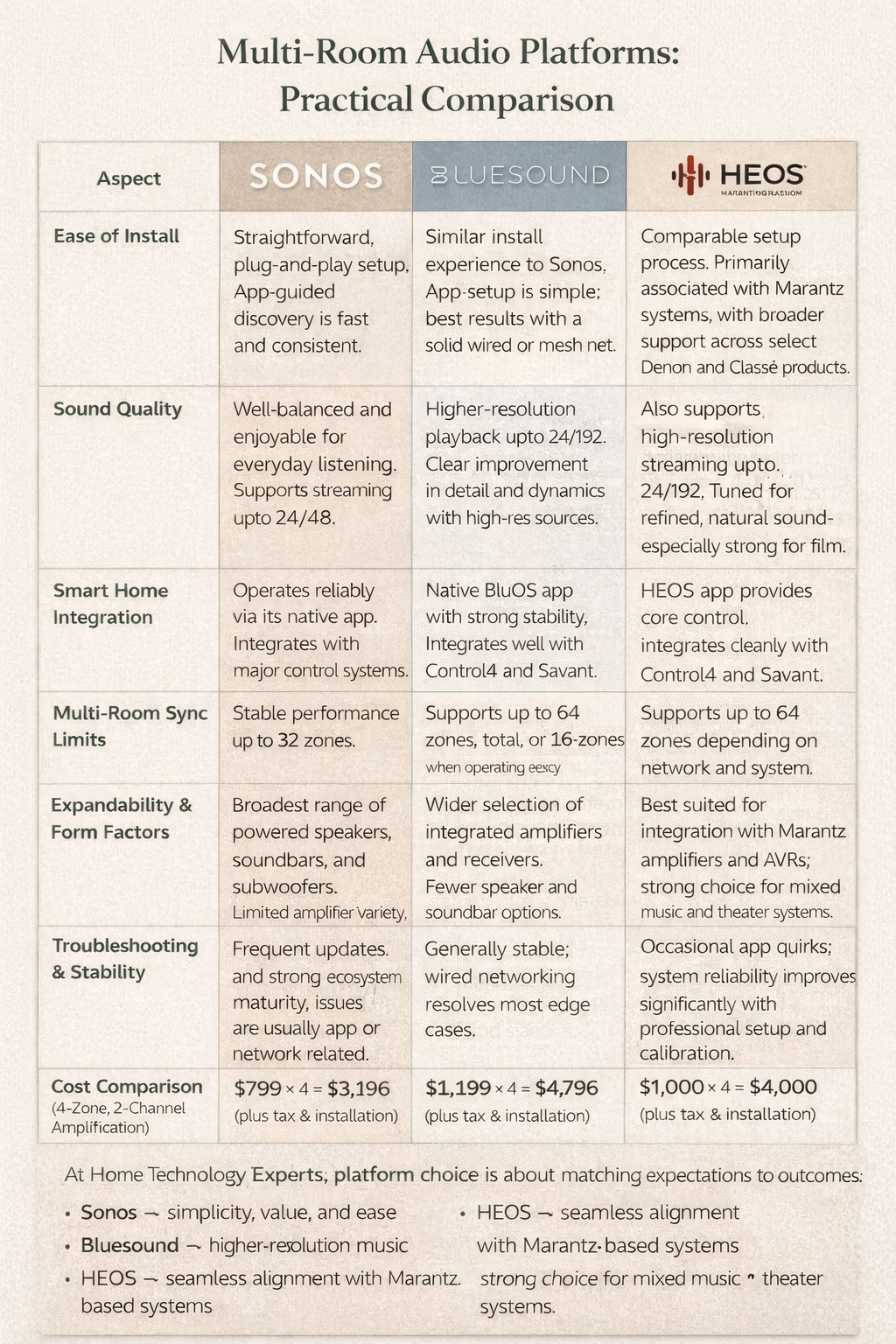
Side by Side Comparison