
What is DALI?
DALI (Digital Addressable Lighting Interface) is a standardised, bi-directional digital lighting control protocol defined by IEC 62386 that enables individual, addressable control, monitoring, and automation of lighting devices within building and smart lighting systems.
What Is DALI (Digital Addressable Lighting Interface)?
DALI (Digital Addressable Lighting Interface) is a widely adopted digital lighting control protocol. It allows lighting systems to be managed and automated with far greater precision than traditional analog methods. DALI provides a standardised way for lighting devices—such as LED drivers, ballasts, dimmers, sensors, switches, and controllers—to communicate reliably over a shared network.
What DALI Is
DALI stands for Digital Addressable Lighting Interface.
It is defined by the international IEC 62386 standard, with certified products carrying the official DALI trademark.
Unlike older analog systems such as 0–10 V, DALI is bi-directional. This means a controller can not only send commands to luminaires, but also receive feedback—such as fault status, operational state, or energy-related data.
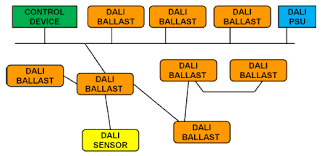
Communication takes place over a simple two-wire bus, which carries both control data and low-voltage power for connected devices.
How DALI Works
Each device on a DALI network is assigned a unique digital address. This allows lights to be controlled individually, organised into groups, or recalled as part of predefined scenes.
A single DALI line typically supports up to 64 devices, with larger installations handled through gateways or routers.
Because communication is bi-directional, the system can report issues such as lamp failures or driver faults back to the controller.
Data is transmitted at relatively low speeds (around 1200 bit/s), which is more than sufficient for lighting control and contributes to system stability.
Versions and Evolution
DALI-1
The original implementation, providing basic addressable control of luminaires.
DALI-2
An enhanced version with formal certification, improved interoperability, and standardised support for control devices such as sensors and switches.
D4i
An extension of DALI-2 focused on luminaire-level intelligence, including diagnostics, asset data, and energy reporting. It is well suited to smart building environments.
DALI+
A newer specification designed to integrate DALI into modern IP-based and IoT networks, while maintaining compatibility with DALI-2.
Key Capabilities
Individual on/off and dimming control of each light
Group and scene management for flexible lighting strategies
Two-way communication with status and fault reporting
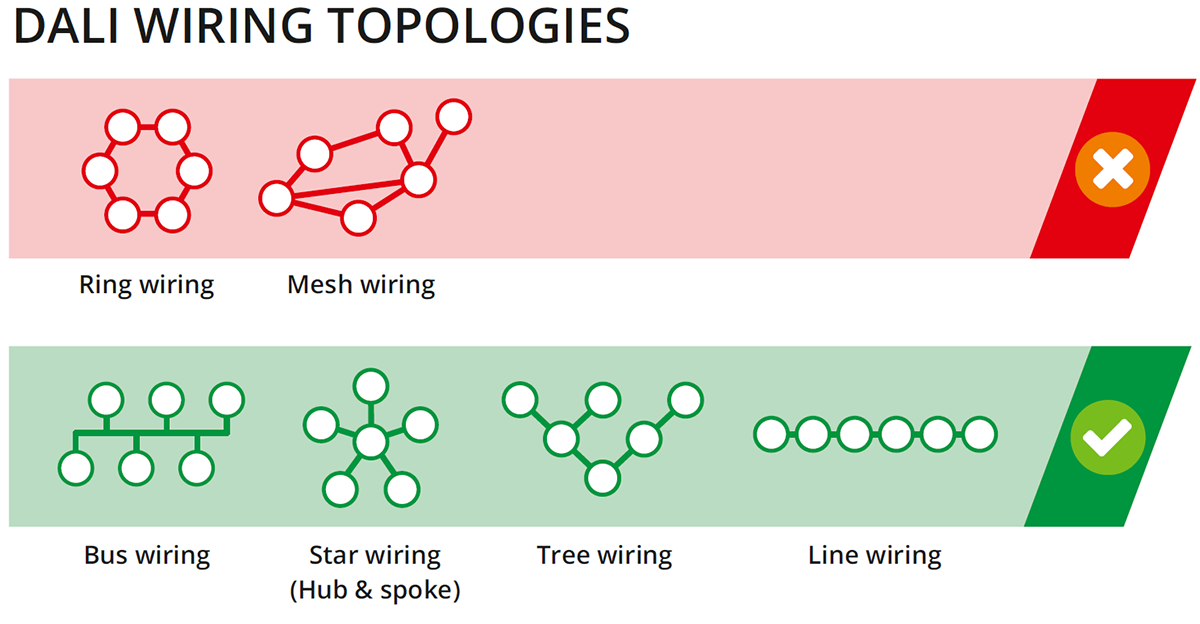
Flexible wiring topologies, including line, star, and tree
Integration with sensors, timers, and automation platforms
Multi-vendor interoperability under DALI-2 certification
Where DALI Is Used
DALI is commonly specified in:
Commercial buildings such as offices and retail spaces
Industrial facilities
Architectural and public environments
Smart building automation systems
It is also increasingly adopted in high-end residential projects where precise control and automation are required.
Benefits
DALI enables improved energy efficiency through daylight and occupancy-based control, reduces maintenance through remote diagnostics, and offers long-term flexibility through standardised, interoperable components.
How DALI Compares to Other Systems
Compared to 0–10 V
0–10 V systems are simple and inexpensive, but lack addressability and feedback. DALI provides precise control and system visibility.
Compared to DMX
DMX is optimised for entertainment and stage lighting, with high-speed, one-way control. DALI is designed for architectural and building applications, prioritising reliability, feedback, and long-term operation.
FAQ: DALI Lighting Control
What does DALI stand for?
DALI stands for Digital Addressable Lighting Interface, a standardised digital protocol for controlling and monitoring lighting systems.
What is DALI lighting control?
DALI lighting control is a bi-directional, addressable lighting control system that allows individual luminaires to be switched, dimmed, grouped, monitored, and automated over a shared two-wire bus.
What standard defines DALI?
DALI is defined by the international IEC 62386 standard. Products certified to this standard may carry the official DALI trademark, ensuring interoperability between manufacturers.
What is the difference between DALI and DALI-2?
DALI-2 is an enhanced and fully certified evolution of DALI that standardises not only luminaires but also control devices such as sensors, switches, and controllers, improving multi-vendor interoperability.
What is D4i?
D4i is a subset of DALI-2 focused on luminaire-level intelligence, enabling energy monitoring, diagnostics, and asset data storage, making it ideal for smart buildings and smart city lighting.
How many devices can be connected to a DALI system?
A single DALI line supports up to 64 addressed devices. Larger installations can be implemented using multiple lines connected via gateways or routers.
Is DALI bi-directional?
Yes. DALI is bi-directional, meaning controllers can send commands to lighting devices and receive feedback such as fault status, operating state, and diagnostic data.
How does DALI compare to 0–10 V lighting control?
Compared to 0–10 V, DALI offers digital addressability, two-way communication, fault reporting, and greater flexibility, whereas 0–10 V provides only basic analog dimming without feedback.
How does DALI differ from DMX?
DMX is designed for entertainment and stage lighting with high-speed, one-way control, while DALI is optimised for architectural and building lighting, prioritising reliability, feedback, and long-term operation.
Where is DALI typically used?
DALI is commonly used in commercial buildings, industrial facilities, architectural spaces, and smart building automation systems, and is increasingly adopted in high-end residential projects.
What are the main benefits of DALI?
Key benefits include energy efficiency, flexible control, reduced maintenance through diagnostics, long-term scalability, and vendor-independent interoperability.
Summary
DALI (Digital Addressable Lighting Interface) is a robust, standardised lighting control protocol that delivers precise control, system feedback, and long-term interoperability. With ongoing evolution through DALI-2, D4i, and DALI+, it remains a cornerstone technology for modern, intelligent lighting systems.
LEARN MORE: LIGHTING DESIGN