
Bose vs. Sonos: Choosing the Right Audio Approach for Your Home
In premium home audio, Bose and Sonos are often compared for good reason. Both offer strong performance, thoughtful design, and a wide range of products.
The better choice depends less on the brand—and more on how the system needs to function within the home.
At HTE, we approach audio as part of a larger system. That means looking beyond individual speakers to consider reliability, coordination, and how the system will be used and supported over time.
Two Different Strengths
Bose and Sonos solve different problems well.
Bose tends to focus on impact.
It delivers a full, immersive sound—especially in TV-focused spaces or rooms centered around media.
Sonos is built for consistency.
It prioritizes stability, ease of use, and the ability to scale audio across the entire home.
Both are effective. The right choice depends on the role audio plays in the project.
Sound Experience
Bose leans toward a warmer, more cinematic sound profile.
It works well in spaces where audio is meant to be felt as much as heard—media rooms, dens, and casual viewing areas.
Sonos takes a more balanced approach.
The sound is consistent across rooms and speaker types, which matters more in whole-home environments where continuity is important.
This is less about which sounds “better” and more about where and how the system will be used.
Whole-Home Audio and Scalability
This is where the distinction becomes more practical.
Sonos is designed as a unified system from the start.
It allows for coordinated audio across multiple rooms, simple control, and predictable performance as the system grows.
Bose offers multi-room capability, but it is typically better suited to standalone or smaller-scale setups.
For projects that require audio throughout the home, consistency and reliability tend to matter more than individual speaker performance.
Integration with the Home
In a fully integrated environment—where audio, lighting, shading, and control systems work together—compatibility becomes critical.
Sonos is generally easier to coordinate within these systems.
It aligns well with common control platforms and supports a more structured, serviceable installation.
Bose works well in simpler setups, but is less often used as the backbone of a fully integrated home.
Home Theater and Portability
There are still clear cases where Bose is the right fit.
For TV-centered spaces, Bose offers strong performance in compact formats with minimal installation requirements.
It also remains a solid choice for portable use, where Bluetooth performance and flexibility are priorities.
Sonos can support home theater as part of a broader system, particularly when paired with architectural speakers or expanded over time.
Ease of Use
For day-to-day use, consistency matters.
Sonos is known for a straightforward control experience, especially in homes with multiple rooms and users.
It is designed to be predictable, which reduces friction over time.
Bose is simple to use in individual spaces, but does not offer the same level of coordination across a full home.
Choosing What Fits the Home
The decision should reflect how the home is designed to function.
Bose is often the right choice when:
The focus is on a primary media space
A compact, high-impact setup is preferred
Portability is a priority
Sonos is often the right choice when:
Audio is distributed across multiple rooms
The system needs to scale over time
Integration with lighting, shading, and control systems is important
Long-term reliability and ease of use are priorities
For many HTE projects, especially larger homes or new construction, a coordinated system tends to deliver a more predictable and supportable result.
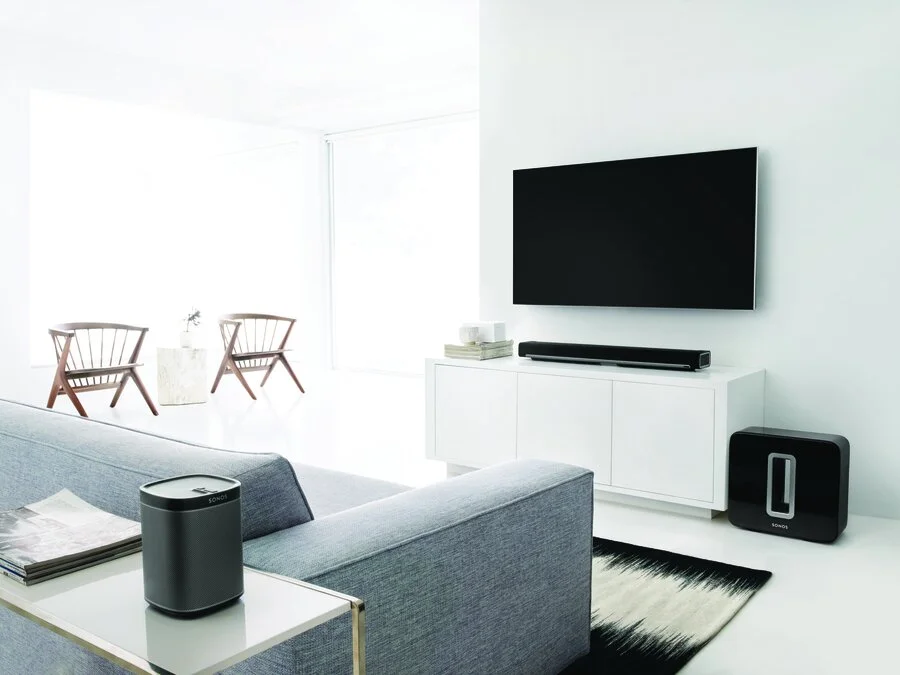
Speakers
Sound Quality: Cinematic vs. Reference-Level Consistency
Bose Sound Quality
Bose leans warm, cinematic, and atmospheric.
Their emphasis is on feel—bass-heavy, immersive, and full-bodied.
Perfect for:
Home theaters
TV-first spaces
Rooms where cinematic impact matters
Some listeners love the heavier low-end. Others find it slightly colored.
Sonos Sound Quality
Sonos goes for neutral, clean, and balanced.
It’s incredibly consistent across each speaker size.
Perfect for:
Whole-home audio
Architectural installations
Background listening
Social and entertaining spaces
Sonos also improves over time with software tuning (Trueplay, room correction).
Winner for pure listening: Bose
Winner for balanced, scalable audio: Sonos
Multi-Room & Whole-Home Audio
This is where the difference becomes dramatic.
Sonos Multi-Room Performance
This is Sonos’ greatest advantage—and the reason HTENY specifies it so often.
Sonos offers:
Perfectly synchronized audio across dozens of rooms
Easy grouping and ungrouping
Independent volume and playback per zone
Seamless expansion over time
Rock-solid wireless reliability
It’s the most mature, intuitive multi-room audio platform on the market.
Bose Multi-Room Performance
Bose once had a competing system (SoundTouch), but it never reached the same reliability or speed as Sonos.
In 2025:
Bose does support multi-room features, but
It is not as seamless, scalable, or universally adopted
Limited architectural integration
Clear winner: Sonos
Considering Bose or Sonos for your home or business? Connect with us below!
The Home Technology Experts Perspective
Both brands are excellent. But they serve different purposes.
Bose is about impact.
Sonos is about organization, scalability, and whole-home harmony.
In a luxury smart home environment—where lighting, shades, networking, and automation all work together—Sonos integrates more cleanly and more predictably. It becomes part of the home’s rhythm, not just a device on a shelf.
Thinking About Audio for Your Smart Home?
Whether you need:
A dedicated theater
Architectural in-ceiling speakers
Outdoor audio
Alexa integration
Or a fully automated Lutron-powered home
Home Technology Experts designs systems that look beautiful, sound incredible, and work effortlessly.
Schedule a consultation with HTE
Let’s build an audio system that feels natural, powerful, and seamlessly connected.