
The Next Satellite Internet Race—and What It Means for Smart Homes in the Hamptons

Getting the best internet access
How do you choose the best internet for your Hamptons home? Optimum, Starlink, and now Amazon Leo.
So… how does Amazon Leo stack up against Starlink today, and what should homeowners in coverage-challenged Hamptons markets know?
Amazon Leo Ultra vs. Starlink: Which is Right for You?
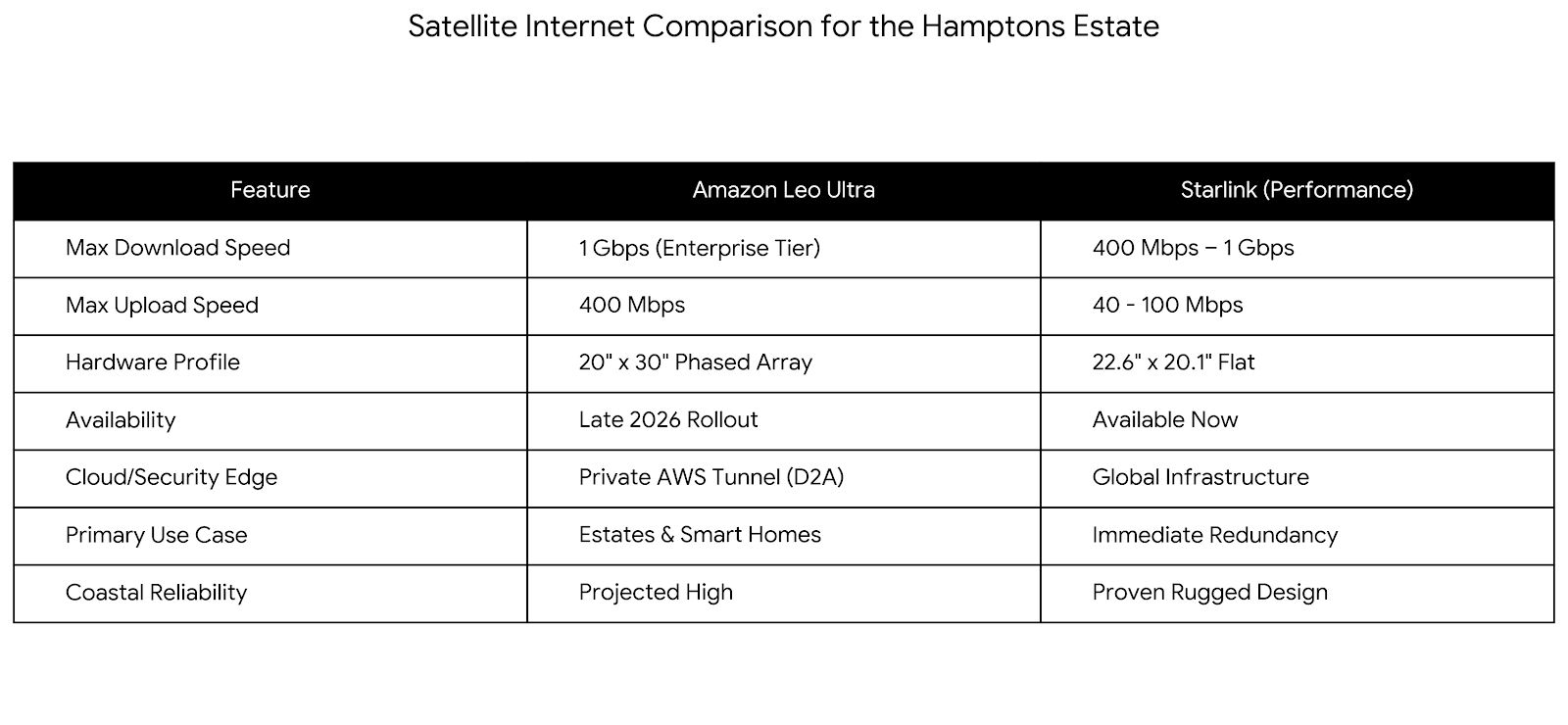
Amazon's new Leo Ultra antenna and Starlink are both contenders in the satellite internet space, each targeting different needs. Here’s a quick comparison:
Amazon Leo Ultra: Built for Serious Use Cases
Amazon’s Leo Ultra antenna is designed for high-demand environments like estates, luxury rentals, and multi-building compounds. With a large 20" x 30" form factor, the Leo Ultra promises:
1 Gbps download
400 Mbps upload
Private networking and cloud connectivity via AWS
In addition to the Ultra, Amazon also offers the Leo Pro (up to 400 Mbps down) and the Leo Nano (up to 100 Mbps down), catering to various needs. However, Leo Ultra isn’t available for homeowners yet—it’s targeted at corporate or estate-level installations, with a wider rollout expected by mid-2026. A limited enterprise beta started around early April 2026 for select business, telecom, and government users. This is not open to the public.
As of April 2026, Amazon has launched prototypes plus roughly 241 production satellites (with ongoing launches). They need hundreds more to meet full coverage and FCC requirements (half the constellation by mid-2026, though they've requested extensions due to delays).
Starlink: Proven, Rugged, and Fast
Starlink, on the other hand, has been available for consumer use for some time and is already a solid performer. The Starlink Performance Kit delivers:
400+ Mbps download
Gigabit speeds expected by 2026
Rugged design for harsh environments (high winds, coastal areas)
Starlink’s V3 satellite platform is already providing gigabit-level service in some areas and will continue to improve. It’s designed for both home and business use, with availability in most parts of the U.S. (including East End) and some waiting periods.
Key Comparison Points
Speed: Amazon Leo Ultra promises higher speeds for enterprise users (1 Gbps down), while Starlink offers around 400 Mbps today, with future gigabit speeds.
Availability: Starlink is available now for most homeowners, while Leo Ultra is in early preview and won’t be available for broader use until 2026.
Ecosystem: Amazon’s Leo Ultra focuses on private networking, secure transport, and AWS cloud integration, which is a potential edge for estates or businesses needing robust security and cloud capabilities. Starlink, while improving business features, currently has the advantage for regular homeowners.
Why Satellite Internet Matters in the Hamptons
In the Hamptons, reliable internet can be hard to come by—especially outside village cores, where fiber is inconsistent, cable nodes congest during peak season, and storms wreak havoc on last-mile infrastructure. Even luxury homes often rely on aging DSL or fixed wireless, making connectivity surprisingly fragile.
In 2025, internet downtime isn’t just an inconvenience; it’s a critical issue. When the connection drops, it impacts everything from security cameras and smart locks to home automation systems and work-from-home continuity. That’s why having redundancy—like satellite internet—is no longer a luxury, but a must-have for any modern home.
Final Verdict: The 2026 Connectivity Outlook
For Hamptons homeowners requiring an immediate, high-performance solution, Starlink remains the gold standard. With its 2026 infrastructure now supporting 1 Gbps bursts in many coastal areas, it is no longer just a "backup" but a primary contender for estate-wide connectivity.
However, for those planning new builds or major renovations for late 2026 and 2027, Amazon Leo Ultra is the one to watch. Its native, secure-tunnel integration with AWS offers a level of digital privacy and corporate-grade stability that is currently unmatched in the satellite space.
Our Recommendation: If your connectivity is "mission-critical," don't choose—integrate both. In the luxury market, the most resilient homes utilize a bonded approach: a primary fiber or cable line backed by a Starlink Performance Kit, with the infrastructure pre-wired to transition to Amazon Leo Ultra as it reaches full Hamptons deployment later this year.
Unleash the Power of Connectivity
Let us help you create a connected home that's efficient, secure, and tailored to your needs.
Content updated April 2026.